| ![Show Contents]() Dure History, Family Crest & Coats of Arms Dure History, Family Crest & Coats of Arms
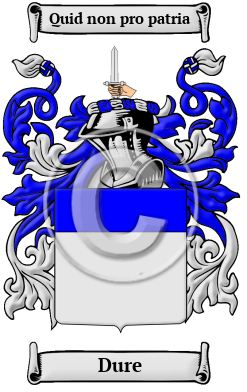
The saga of the name Dure begins with the people of the Pictish clans. Dure was a name for a pilgrim from the Gaelic word deoradh. The deoradh kept the relics of saints. The family have been the hereditary custodians of St. Fillan's Crozier. 1 Early Origins of the Dure familyThe surname Dure was first found in Perthshire (Gaelic: Siorrachd Pheairt) former county in the present day Council Area of Perth and Kinross, located in central Scotland. Dewarton is a village, in the parish of Borthwick, county of Edinburgh. It is here that the Dewar family have held the estate of Vogrie since early times. 2 Early History of the Dure familyThis web page shows only a small excerpt of our Dure research. Another 122 words (9 lines of text) covering the year 1296 is included under the topic Early Dure History in all our PDF Extended History products and printed products wherever possible. Dure Spelling VariationsScribes in the Middle Ages did not have access to a set of spelling rules. They spelled according to sound, the result was a great number of spelling variations. In various documents, Dure has been spelled Dewar, Dure, Dewyer, Dewer, McIndeor, McJarrow and many more. Early Notables of the Dure familyMore information is included under the topic Early Dure Notables in all our PDF Extended History products and printed products wherever possible.
 Dure migration to the United States Dure migration to the United States | + |
The cruelties suffered under the new government forced many to leave their ancient homeland for the freedom of the North American colonies. Those who arrived safely found land, freedom, and opportunity for the taking. These hardy settlers gave their strength and perseverance to the young nations that would become the United States and Canada. Immigration and passenger lists have shown many early immigrants bearing the name Dure:
Dure Settlers in United States in the 17th Century- Thomas Dure, who arrived in Maryland in 1683 3
Dure Settlers in United States in the 19th Century- Francis Dure, who landed in Savanna(h), Georgia in 1837 3
The motto was originally a war cry or slogan. Mottoes first began to be shown with arms in the 14th and 15th centuries, but were not in general use until the 17th century. Thus the oldest coats of arms generally do not include a motto. Mottoes seldom form part of the grant of arms: Under most heraldic authorities, a motto is an optional component of the coat of arms, and can be added to or changed at will; many families have chosen not to display a motto.
Motto: Quid non pro patria
Motto Translation: What would not one do for his country.
- Black, George F., The Surnames of Scotland Their Origin, Meaning and History. New York: New York Public Library, 1946. Print. (ISBN 0-87104-172-3)
- Lewis, Samuel, A Topographical Dictionary of Scotland. Institute of Historical Research, 1848, Print.
- Filby, P. William, Meyer, Mary K., Passenger and immigration lists index : a guide to published arrival records of about 500,000 passengers who came to the United States and Canada in the seventeenth, eighteenth, and nineteenth centuries. 1982-1985 Cumulated Supplements in Four Volumes Detroit, Mich. : Gale Research Co., 1985, Print (ISBN 0-8103-1795-8)
|

 Dure migration to the United States

 France
 Germany
 Scotland