| ![Show Contents]() Dole History, Family Crest & Coats of Arms Dole History, Family Crest & Coats of Arms
Etymology of DoleWhat does the name Dole mean? The spelling and overall form of Irish names often vary considerably. The original Gaelic form of the name Dole is Ó Dubhghaill, derived from the words dubh, which means black, and ghall, which means foreigner, or "dubhgall," which meant "dark and tall." (O'Hart) Early Origins of the Dole familyThe surname Dole was first found in the counties of Wicklow, Wexford, and Carlow. Although the name is now common throughout Ireland, it has always retained a close association with these southeastern Leinster counties. Although at least one historian gives their descent from Dubhgilla, King of Idrone in Leinster, more evidence points to descent from King Conn of the "Hundred Battles." His name comes from the hundreds of battles he fought and won, before his death in the 2nd century. It is traditionally believed that the family takes its name from a Norseman who settled in Ireland prior to the Norman Conquest; a theory that is borne out by the fact that the Doyles tended to be more concentrated in the coastal regions favored by Norse settlers. Moreover, the Gaelic word dubhghall was used in early times to refer to a Norseman or Scandinavian. With the settlement of Norsemen in various places, several distinct septs called O Dubhghail probably arose independently. 1 Early History of the Dole familyThis web page shows only a small excerpt of our Dole research. Another 153 words (11 lines of text) covering the years 1786, 1797, 1834, 1868, 1873 and 1917 are included under the topic Early Dole History in all our PDF Extended History products and printed products wherever possible. Dole Spelling VariationsThe spelling of names in Ireland during the Middle Ages was rarely consistent. This inconsistency was due to the scribes and church officials' attempts to record orally defined names in writing. The common practice of recording names as they sounded resulted in spelling variations such as Doyle, O'Doyle, Doyill, Doill, Doile, Doyel and others. Early Notables of the Dole familyAnother 38 words (3 lines of text) are included under the topic Early Dole Notables in all our PDF Extended History products and printed products wherever possible. Dole Rankingthe United States, the name Dole is the 8,306th most popular surname with an estimated 2,487 people with that name. 2
| Dole migration to the United States | + |
Many destitute Irish families in the 18th and 19th centuries decided to leave their homeland, which had in many ways been scarred by English colonial rule. One of the most frequent destinations for these families was North America where it was possible for an Irish family to own their own parcel of land. Many of the early settlers did find land awaiting them in British North America, or even later in America, but for the majority of immigrants that arrived as a result of the Great Potato Famine of the late 1840s the ownership of land was often a long way off. These Irish people were initially put to work on such industrial projects as the building of bridges, canals, and railroads, or they worked at manufacturing positions within factories. Whenever they arrived, the Irish made enormous contributions to the infant nations of Canada and the United States. Some of the earliest immigrants to bearer the name of Dole were found through extensive research of immigration and passenger lists:
Dole Settlers in United States in the 17th Century- Richard Dole, who arrived in Jamestown, Va in 1607. attempted a settlement in Willamsburg, 3
- Peter Dole, aged 20, who arrived in Virginia in 1634 aboard the ship "Bonaventure" coming via St. Domingo 3
- George Dole, who arrived in Lynn, Massachusetts in 1637 3
- Richard Dole, who arrived in Newbury, Massachusetts in 1640 3
- Judith Dole, who arrived in Virginia in 1660 3
- ... (More are available in all our PDF Extended History products and printed products wherever possible.)
Dole Settlers in United States in the 18th Century- Anthony Dole, who arrived in Boston, Massachusetts in 1766 3
| Dole migration to Canada | + |
Dole Settlers in Canada in the 19th Century- William M Dole, who landed in Canada in 1831
- James Dole, who arrived in Nova Scotia, Canada sometime between the years 1598-1867
| Dole migration to Australia | + |
Dole Settlers in Australia in the 19th Century- Mr. Thomas Dole, English convict who was convicted in Gloucester, England for 7 years, transported aboard the "Atlas" on 16th January 1816, arriving in New South Wales, Australia 4
- Mr. Isaac Dole, English convict who was convicted in Bristol, England for 14 years, transported aboard the "Canada" on 23rd April 1819, arriving in New South Wales, Australia 5
- Mary Dole, aged 18, a domestic servant, who arrived in South Australia in 1853 aboard the ship "Shackamaxon" 6
| Dole migration to New Zealand | + |
Emigration to New Zealand followed in the footsteps of the European explorers, such as Captain Cook (1769-70): first came sealers, whalers, missionaries, and traders. By 1838, the British New Zealand Company had begun buying land from the Maori tribes, and selling it to settlers, and, after the Treaty of Waitangi in 1840, many British families set out on the arduous six month journey from Britain to Aotearoa to start a new life. Early immigrants include: Dole Settlers in New Zealand in the 19th Century- Ellen Dole, who arrived in Auckland, New Zealand aboard the ship "Chile" in 1871
| Contemporary Notables of the name Dole (post 1700) | + |
- Robert Joseph "Bob" Dole (1923-2021), American politician, United States senator (1969-1996), and Republican presidential candidate in 1996, awarded the Congressional Gold Medal in January 2018
- Emily Dole (1957-2018), Samoan-American athlete, actress and professional wrestler
- William P. Dole, American Republican politician, Delegate to Republican National Convention from Illinois, 1860
- Robert Joseph Dole (b. 1923), American Republican politician, Member of Kansas State House of Representatives, 1951-53; U.S. Representative from Kansas, 1961-69; U.S. Senator from Kansas, 1969-96; Resigned 1996; Chairman of Republican National Committee, 1971-73; Candidate for Vice President of the United States, 1976; Candidate for Republican nomination for President, 1980, 1988; Candidate for President of the United States, 1996
- Robert A. Dole, American Republican politician, Candidate for Governor of California, 2003
- John W. Dole, American Republican politician, Member of New Hampshire State Senate 5th District; Elected 1948
- Harry S. Dole, American Democratic Party politician, Delegate to Democratic National Convention from Kansas, 1952 (member, Committee on Permanent Organization)
- Elizabeth Hanford Dole (b. 1936), American Republican politician, Member, Federal Trade Commission, 1973-79; U.S. Secretary of Transportation, 1983-87; U.S. Secretary of Labor, 1989-90; President, American Red Cross, 1991-2000; Candidate for Republican nomination for President, 2000; U.S. Senator from North Carolina, 2003-
- Charles Dole, American politician, Member of Vermont State House of Representatives from Northfield, 1888
- ... (Another 19 notables are available in all our PDF Extended History products and printed products wherever possible.)
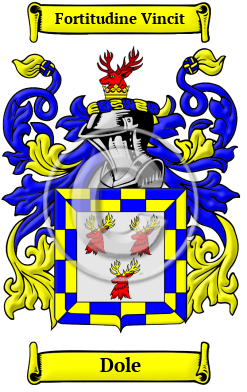
The motto was originally a war cry or slogan. Mottoes first began to be shown with arms in the 14th and 15th centuries, but were not in general use until the 17th century. Thus the oldest coats of arms generally do not include a motto. Mottoes seldom form part of the grant of arms: Under most heraldic authorities, a motto is an optional component of the coat of arms, and can be added to or changed at will; many families have chosen not to display a motto.
Motto: Fortitudine Vincit
Motto Translation: He conquers by fortitude.
- MacLysaght, Edward, Irish Families Their Names, Arms and Origins 4th Edition. Dublin: Irish Academic, 1982. Print. (ISBN 0-7165-2364-7)
- "What are the 5,000 Most Common Last Names in the U.S.?". NameCensus.com, https://namecensus.com/last-names/
- Filby, P. William, Meyer, Mary K., Passenger and immigration lists index : a guide to published arrival records of about 500,000 passengers who came to the United States and Canada in the seventeenth, eighteenth, and nineteenth centuries. 1982-1985 Cumulated Supplements in Four Volumes Detroit, Mich. : Gale Research Co., 1985, Print (ISBN 0-8103-1795-8)
- Convict Records Voyages to Australia (Retrieved 14th July 2020). Retrieved from https://convictrecords.com.au/ships/atlas
- Convict Records Voyages to Australia (Retrieved 9th December 2020). Retrieved from https://convictrecords.com.au/ships/canada
- South Australian Register Thursday 20 January 1853. (Retrieved 2010, November 5) SHACKAMAXON 1853. Retrieved http://www.theshipslist.com/ships/australia/shackamaxon1853.shtml
 |