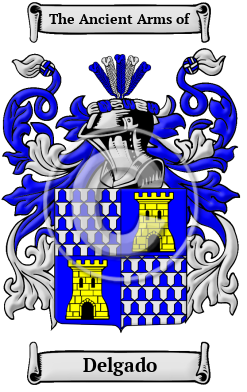
| ![Show Contents]() Delgado History, Family Crest & Coats of Arms Delgado History, Family Crest & Coats of Arms
- Origins Available:
 Italy Italy Spain Spain The distinguished Spanish name Delgado is a nickname type of surname for a thin person. Originally, the Spanish people were known only by a single name. The process by which hereditary surnames were adopted in Spain is extremely interesting. Surnames evolved during the Middle Ages when people began to assume an extra name to avoid confusion and to further identify themselves. Often they adopted names that were derived from nicknames. Frequently, nickname surnames, such as Delgado, reflected the physical characteristics or attributes of the first person that used the name. The name Delgado is derived from the Spanish word "delgado," which means slender, and the Latin word "delicatus," which means dainty or exquisite. Early Origins of the Delgado familyThe surname Delgado was first found in Castile, predominant among the Christian kingdoms of medieval Spain. Early History of the Delgado familyThis web page shows only a small excerpt of our Delgado research. Another 57 words (4 lines of text) covering the year 1258 is included under the topic Early Delgado History in all our PDF Extended History products and printed products wherever possible. Delgado Spelling VariationsSpelling variations of this family name include: Delgado, Delgadillo and others. Early Notables of the Delgado familyProminent among members of the family - were sixteenth century Spanish sculptor Pedro Delgado
- eighteenth century Spanish bullfighter José Delgado, known also as "Pepe Hillo"
- José Matías Delgado, nineteenth century Salvadoran politician and first President of El Salvador
Delgado World RankingIn the United States, the name Delgado is the 358th most popular surname with an estimated 74,610 people with that name. 1 However, in France, the name Delgado is ranked the 3,075th most popular surname with an estimated 2,000 - 2,500 people with that name. 2 And in South America, the name Delgado is the 77th popular surname with an estimated 59 people with that name. 3
 Delgado migration to the United States Delgado migration to the United States | + |
Some of the first settlers of this family name were: Delgado Settlers in United States in the 16th Century- Diego Delgado, who arrived in America in 1513 4
- Andres Delgado, who settled in New Spain in 1571
- Ana Raposa Delgado, who settled in New Spain in 1579
Delgado Settlers in United States in the 18th Century- Alonzo Delgado, who settled in California sometime between 1796 and 1802
Delgado Settlers in United States in the 19th Century- Alonzo Delgado, who settled in California in 1796-1802
- Barbara Delgado, who arrived in Puerto Rico in 1803 4
- Manuel Delgado, who arrived in Puerto Rico in 1803 4
- Martin Delgado, who landed in America in 1812 4
- Juan Delgado, who landed in America in 1812 4
- ... (More are available in all our PDF Extended History products and printed products wherever possible.)
| Delgado migration to West Indies | + |
The British first settled the British West Indies around 1604. They made many attempts but failed in some to establish settlements on the Islands including Saint Lucia and Grenada. By 1627 they had managed to establish settlements on St. Kitts (St. Christopher) and Barbados, but by 1641 the Spanish had moved in and destroyed some of these including those at Providence Island. The British continued to expand the settlements including setting the First Federation in the British West Indies by 1674; some of the islands include Barbados, Bermuda, Cayman Island, Turks and Caicos, Jamaica and Belize then known as British Honduras. By the 1960's many of the islands became independent after the West Indies Federation which existed from 1958 to 1962 failed due to internal political conflicts. After this a number of Eastern Caribbean islands formed a free association. 5Delgado Settlers in West Indies in the 18th Century- Alonso Delgado, who arrived in Cuba
| Contemporary Notables of the name Delgado (post 1700) | + |
- Emilio Delgado (1940-2022), American film and stage actor, voice artist, and singer best known for his role as Luis, the Fix-it Shop owner, on the children's television series Sesame Street (1971-2016)
- James P. Delgado (b. 1958), award-winning American maritime archaeologist, explorer and author
- John Delgado, American Republican politician, Alternate Delegate to Republican National Convention from Texas, 2008 6
- Jesse L. Delgado, American Democratic Party politician, Delegate to Democratic National Convention from California, 1972 6
- Gustavo A. Delgado, American Democratic Party politician, Delegate to Democratic National Convention from California, 2008 6
- Gilbert Delgado, American Democratic Party politician, Delegate to Democratic National Convention from Illinois, 2000, 2004 (alternate) 6
- Francisco Afan Delgado (1886-1964), American politician, Member of the Phillipine Islands House of Representatives, 1931-34; Resident Commissioner to U.S. Congress from the Phillipine Islands, 1935-36 6
- Cirilo Tirado Delgado, American Democratic Party politician, Delegate to Democratic National Convention from Puerto Rico, 1996 6
- Christine Delgado, American Democratic Party politician, Delegate to Democratic National Convention from California, 2004 6
- Bruce Carlos Delgado, American politician, Candidate for Mayor of Marina, California, 2004 6
- ... (Another 21 notables are available in all our PDF Extended History products and printed products wherever possible.)
- "What are the 5,000 Most Common Last Names in the U.S.?". NameCensus.com, https://namecensus.com/last-names/
- http://www.journaldesfemmes.com/nom-de-famille/nom/
- "List of most common surnames in South America." Wikipedia, https://en.wikipedia.org/wiki/List_of_most_common_surnames_in_South_America
- Filby, P. William, Meyer, Mary K., Passenger and immigration lists index : a guide to published arrival records of about 500,000 passengers who came to the United States and Canada in the seventeenth, eighteenth, and nineteenth centuries. 1982-1985 Cumulated Supplements in Four Volumes Detroit, Mich. : Gale Research Co., 1985, Print (ISBN 0-8103-1795-8)
- https://en.wikipedia.org/wiki/British_West_Indies
- The Political Graveyard: Alphabetical Name Index. (Retrieved 2015, October 22) . Retrieved from http://politicalgraveyard.com/alpha/index.html
|

 Delgado migration to the United States
  Delgado migration to West Indies