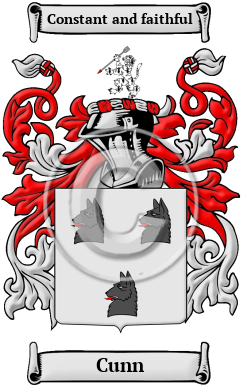
The Cunn family history stretches back to the clans of the Dalriadan kingdom on the sea-swept Hebrides islands and mountainous western coast of Scotland. The name Cunn is derived from Suibhne, an old Gaelic forename which probably means good-going or well-going. The Gaelic form of the surname is Mac Shuibhne.
Loading...
Early Origins of the Cunn family
The surname Cunn was first found in on the Isles of Skye and Lewis (Scottish Gaelic: Leòdhas), where they were originally a branch of the MacDonalds of Clanranald. But although the MacQueens held lands of Garafad on the Isle of Skye for several centuries it is likely that the first MacQueen was the Lord of Knapdale in Argyllshire who held Castle Sween.
Early History of the Cunn family
This web page shows only a small excerpt of our Cunn research. Another 136 words (10 lines of text) covering the years 1411 and 1743 are included under the topic Early Cunn History in all our PDF Extended History products and printed products wherever possible.
Cunn Spelling Variations
Medieval translation of Gaelic names could not be referred to as an accurate process. Spelling was not yet standardized, and names in documents from that era are riddled with spelling variations. Cunn has been written as MacQueen, MacQueon, MacSween, MacSwene, MacSweyne, MacSwan, MacCunn and many more.
Early Notables of the Cunn family
MacQueen of Pall à Chrocain, a legendary Highland deer stalker popularly believed to have slain the last wolf Tarnaway Forest in the province of Morayshire in 1743. Apparently, he received a message from his chief, the Laird of Clan Mackintosh, that a black wolf had killed two children. He arrived late for the meeting, received a tirade from his chief only to reveal from under his garment the head of the wolf. He described the event as follows: "As I came through the slochk (ravine) by... Another 84 words (6 lines of text) are included under the topic Early Cunn Notables in all our PDF Extended History products and printed products wherever possible.
Migration of the Cunn family to Ireland
Some of the Cunn family moved to Ireland, but this topic is not covered in this excerpt. Another 48 words (3 lines of text) about their life in Ireland is included in all our PDF Extended History products and printed products wherever possible.
Loading...
Loading...
Loading...
Loading...
Migration of the Cunn family
The descendants of the Dalriadan families who made the great crossing of the Atlantic still dot communities along the east coast of the United States and Canada. In the American War of Independence, many of the settlers traveled north to Canada as United Empire Loyalists. Clan societies and highland games have allowed Canadian and American families of Scottish descent to recover much of their lost heritage. Investigation of the origins of family names on the North American continent has revealed that early immigrants bearing the name Cunn or a variant listed above include: Alexander, David, Dugald, Dun, Hector, John McQueen all settled in South Carolina in 1716; John McQueen was banished from the west of England in 1685 to New Jersey..
The motto was originally a war cry or slogan. Mottoes first began to be shown with arms in the 14th and 15th centuries, but were not in general use until the 17th century. Thus the oldest coats of arms generally do not include a motto. Mottoes seldom form part of the grant of arms: Under most heraldic authorities, a motto is an optional component of the coat of arms, and can be added to or changed at will; many families have chosen not to display a motto.
Motto: Constant and faithful
Remove Item
WARNING!
Removing this item from your shopping cart will remove your associated sale items.
Are you sure you want to delete this item from your shopping cart?