| ![Show Contents]() Comer History, Family Crest & Coats of Arms Comer History, Family Crest & Coats of Arms
Etymology of ComerWhat does the name Comer mean? In ancient Anglo-Saxon England, the ancestors of the Comer surname lived in a small valley. The surname Comer is derived from the Old English word cumb, which means valley. The surname Comer belongs to the large class of Anglo-Saxon topographic surnames, which were given to people who resided near physical features such as hills, streams, churches, or types of trees. Alternatively, the name could have been an occupational name for 'the comber,' as in 'the wool comber.' 1 "The early importance of this occupation was bound to create and preserve this surname. " 2 Early Origins of the Comer familyThe surname Comer was first found in various counties an shires throughout ancient Britain. By example, the Hundredorum Rolls of 1273 listed: Richard le Cumbere in Cambridgeshire; and John le Cumbur in Oxfordshire. 2 Ralph (le) Cambere was listed in the Pipe Rolls for Lincolnshire (1201-1202.) Reginald Combere (le Camber) was found in the Curia Regis Rolls for Hertfordshire in 1220 and Ralph le Combere and William le Comere were found in Norfolk in 1286. William le Combere was listed in the Assize Rolls of Cheshire in 1260 and later, John Comber was listed in the Subsidy Rolls of Sussex in 1296. 3 John a Kent and John a Cumber is a sixteenth-century English play by Anthony Munday (c. 1560-1633.) The exact dating of the play is not known but we do know that it was being performed on stage as early as 1587. It is generally thought that in this case, the comedic play's character was in fact John a' Cumber (relating to Cumberland) The play has parallels with Shakespeare's Midsummer Night's Dream. Early History of the Comer familyThis web page shows only a small excerpt of our Comer research. Another 72 words (5 lines of text) covering the years 1260, 1296, 1575, 1631, 1644, 1645, 1649, 1653, 1660, 1689 and 1699 are included under the topic Early Comer History in all our PDF Extended History products and printed products wherever possible. Comer Spelling VariationsIt is only in the last few hundred years that the English language has been standardized. For that reason, early Anglo-Saxon surnames like Comer are characterized by many spelling variations. As the English language changed and incorporated elements of other European languages, even literate people changed the spelling of their names. The variations of the name Comer include: Comber, Comer, Commber, Commer, Combers, Commers and others. Early Notables of the Comer familyThomas Comber (1575-1653), an English linguist, Dean of Carlisle and Master of Trinity College, Cambridge (1631-1645.) He was born at Shermanbury, Sussex, on 1 Jan. 1575, being the twelfth son of his father, who was a barrister-at-law. 4
Thomas Comber (1645-1699), was an English churchman from Barkham, Sussex, Dean of Durham from 1689. He "was descended from an ancient family at Barkham, Sussex. His father, James Comber, was the fourth son of John Comber, who was uncle to Thomas Comber, Dean of Carlisle. Thomas was born at Westerham on 19 March 1644-5, and was the last child baptised in the...
Another 98 words (7 lines of text) are included under the topic Early Comer Notables in all our PDF Extended History products and printed products wherever possible. Comer Rankingthe United States, the name Comer is the 1,945th most popular surname with an estimated 14,922 people with that name. 5 Migration of the Comer family to IrelandSome of the Comer family moved to Ireland, but this topic is not covered in this excerpt.
Another 48 words (3 lines of text) about their life in Ireland is included in all our PDF Extended History products and printed products wherever possible.
| Comer migration to the United States | + |
Many English families tired of political and religious strife left Britain for the new colonies in North America. Although the trip itself offered no relief - conditions on the ships were extremely cramped, and many travelers arrived diseased, starving, and destitute - these immigrants believed the opportunities that awaited them were worth the risks. Once in the colonies, many of the families did indeed prosper and, in turn, made significant contributions to the culture and economies of the growing colonies. An inquiry into the early roots of North American families has revealed a number of immigrants bearing the name Comer or a variant listed above:
Comer Settlers in United States in the 17th Century- Thomas Comer, who arrived in Virginia in 1652 6
- John Comer who settled in New England between 1620 and 1660
- Jane Comer, who landed in Virginia in 1699 6
Comer Settlers in United States in the 18th Century- Jean Comer, who arrived in Pennsylvania in 1736 6
- Richard Comer, who settled in America in 1773
- George Stibband Comer, who settled in Maryland in 1776
Comer Settlers in United States in the 19th Century- Manuel Comer, aged 35, who arrived in New Orleans, La in 1829 6
- Francisco Comer, aged 30, who arrived in New Orleans, La in 1835 6
- I F Comer, who arrived in San Francisco, California in 1851 6
- Henry B Comer, who landed in Allegany (Allegheny) County, Pennsylvania in 1859 6
| Comer migration to Canada | + |
Comer Settlers in Canada in the 18th Century- Private Jacob Comer U.E. born in New York, USA from New York, USA who settled in Con 5 Lot 14, Violet, Ernestown, Lennox & Addington, Ontario c. 1783; he served in the Loyal Rangers Regiment, married to Deborah Hicks 7
- Mr. Paul Comer U.E. who settled in Canada c. 1783 7
| Comer migration to Australia | + |
Comer Settlers in Australia in the 19th Century- Mr. Luke Comer, English convict who was convicted in Middlesex, England for 14 years, transported aboard the "Elizabeth" in May 1816, arriving in New South Wales, Australia 8
- Joseph Comer, English convict from Southampton, who was transported aboard the "Arab" on July 3, 1822, settling in Van Diemen's Land, Australia 9
- Samuel Comer, English convict from Somerset, who was transported aboard the "Asia" on July 29th, 1823, settling in Van Diemen's Land, Australia 10
- Robert Comer, who arrived in Adelaide, Australia aboard the ship "Sir Charles Forbes" in 1839 11
- Mr. Martin Comer, English convict who was convicted in Clerkenwell, London, England for 7 years, transported aboard the "Barossa" on 9th May 1844, arriving in Tasmania (Van Diemen's Land) 12
| Contemporary Notables of the name Comer (post 1700) | + |
- Jon Comer (1976-2019), American professional skateboarder, the first with a prosthetic limb
- Fred Comer (1893-1928), American racecar driver
- Gary Comer (1927-2006), American businessman and philanthropist, founder of mail order clothing retailer Lands' End, eponym of the Comer Children's Hospital at the University of Chicago
- James Pierpont Comer (b. 1934), American Maurice Falk Professor of Child Psychiatry at the Yale Child Study Center, Associate Dean at the Yale School of Medicine
- James R. Comer (b. 1972), American politician, Agriculture Commissioner of Kentucky (2012-)
- Harry Wayne Comer (b. 1944), American former Major League Baseball outfielder
- Samuel "Sam" Comer (1893-1974), American four-time Academy Award winning set decorator, father of Anjanette Comer
- Anjanette Comer (b. 1939), American Primetime Emmy Award nominated actress
- Braxton Bragg Comer (1848-1927), American planter, businessman, and politician, the 33rd Governor of Alabama from 1907 to 1911
- ... (Another 17 notables are available in all our PDF Extended History products and printed products wherever possible.)
| Historic Events for the Comer family | + |
- James Comer (d. 1942), British Stoker 1st Class aboard the HMS Cornwall when she was struck by air bombers and sunk; he died in the sinking 13
The motto was originally a war cry or slogan. Mottoes first began to be shown with arms in the 14th and 15th centuries, but were not in general use until the 17th century. Thus the oldest coats of arms generally do not include a motto. Mottoes seldom form part of the grant of arms: Under most heraldic authorities, a motto is an optional component of the coat of arms, and can be added to or changed at will; many families have chosen not to display a motto.
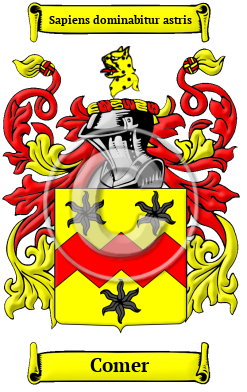
Motto: Sapiens dominabitur astris
Motto Translation: A wise man can rule the stars.
- Lower, Mark Anthony, Patronymica Britannica, A Dictionary of Family Names of the United Kingdom. London: John Russel Smith, 1860. Print.
- Bardsley, C.W, A Dictionary of English and Welsh Surnames: With Special American Instances. Wiltshire: Heraldry Today, 1901. Print. (ISBN 0-900455-44-6)
- Reaney, P.H and R.M. Wilson, A Dictionary of English Surnames. London: Routledge, 1991. Print. (ISBN 0-415-05737-X)
- Smith, George (ed), Dictionary of National Biography. London: Smith, Elder & Co., 1885-1900. Print
- "What are the 5,000 Most Common Last Names in the U.S.?". NameCensus.com, https://namecensus.com/last-names/
- Filby, P. William, Meyer, Mary K., Passenger and immigration lists index : a guide to published arrival records of about 500,000 passengers who came to the United States and Canada in the seventeenth, eighteenth, and nineteenth centuries. 1982-1985 Cumulated Supplements in Four Volumes Detroit, Mich. : Gale Research Co., 1985, Print (ISBN 0-8103-1795-8)
- Rubincam, Milton. The Old United Empire Loyalists List. Genealogical Publishing Co., Inc, 1976. (Originally published as; United Empire Loyalists. The Centennial of the Settlement of Upper Canada. Rose Publishing Company, 1885.) ISBN 0-8063-0331-X
- Convict Records Voyages to Australia (Retrieved 1st March 2022). Retrieved from https://convictrecords.com.au/ships/elizabeth
- State Library of Queensland. (Retrieved 2016, October 27) Arab voyage to Van Diemen's Land, Australia in 1822 with 155 passengers. Retrieved from http://www.convictrecords.com.au/ships/arab/1822
- State Library of Queensland. (Retrieved 2016, October 27) Asia 1 voyage to Van Diemen's Land, Australia in 1823 with 151 passengers. Retrieved from http://www.convictrecords.com.au/ships/asia/1823
- State Records of South Australia. (Retrieved 2010, November 5) SIR CHARLES FORBES (originally Charles Forbes) 1839. Retrieved from http://www.slsa.sa.gov.au/BSA/1839SirCharlesForbes.htm
- Convict Records Voyages to Australia (Retrieved 24th September 2020). Retrieved from https://convictrecords.com.au/ships/barossa
- Force Z Survivors Crew List HMS Cornwall (Retrieved 2018, February 13th) - Retrieved from https://www.forcez-survivors.org.uk/biographies/listcornwallcrew.html#A
 |