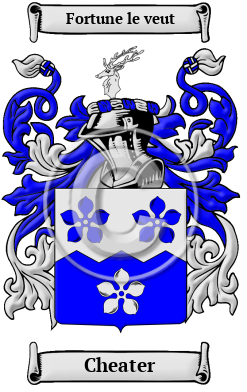
| ![Show Contents]() Cheater History, Family Crest & Coats of Arms Cheater History, Family Crest & Coats of Arms
- Origins Available:
England
Etymology of CheaterWhat does the name Cheater mean? The name Cheater reached English shores for the first time with the ancestors of the Cheater family as they migrated following the Norman Conquest of 1066. The Cheater family lived in Bedfordshire. They were originally from Carteret Manche, Normandy, 1 having derived their name from the Ancient French word acatour, or acateor,which both mean "buyer" as in "buyer of provisions for a large household." 2 Other sources claim the name was "derived from the office of king's escheator-the person appointed to inquire into escheats, or property lapsing to the crown through want of heirs and other causes." 3 4 Early Origins of the Cheater familyThe surname Cheater was first found in Bedfordshire where William le CHatur was listed in the Curia Regis Rolls for 1220. A few years later in Cambridgeshire, Robert le Achatour was recorded in 1229 and later Amicia Lakature and Elias le Katur was listed there in 1271. Early Oxfordshire records show William le Catour, le Chatur, le Katour was listed at Balliol in 1310. 2 The Hundredorum Rolls of 1273 include an entry for Henry Escactor, Oxfordshire; Walter le Chatur, Cambridgeshire; and Agnes le Chatur, Cambridgeshire. 4 The source Testa de Nevill, sive Liber Feodorum, temp. Henry III-Edward I includes two entries: Ralph le Chatere, Warwickshire; and Stephen le Chatere, Warwickshire. 5. Early History of the Cheater familyThis web page shows only a small excerpt of our Cheater research. Another 128 words (9 lines of text) covering the years 1090, 1178, 1494, 1639, 1671, 1721, 1737 and 1801 are included under the topic Early Cheater History in all our PDF Extended History products and printed products wherever possible. Cheater Spelling VariationsAnglo-Norman names tend to be marked by an enormous number of spelling variations. This is largely due to the fact that Old and Middle English lacked any spelling rules when Norman French was introduced in the 11th century. The languages of the English courts at that time were French and Latin. These various languages mixed quite freely in the evolving social milieu. The final element of this mix is that medieval scribes spelled words according to their sounds rather than any definite rules, so a name was often spelled in as many different ways as the number of documents it appeared in. The name was spelled Chaytor, Chater, Chaters, Chator, Chators and others. Early Notables of the Cheater familyAnother 40 words (3 lines of text) are included under the topic Early Cheater Notables in all our PDF Extended History products and printed products wherever possible.
| Cheater migration to the United States | + |
Because of the political and religious discontent in England, families began to migrate abroad in enormous numbers. Faced with persecution and starvation at home, the open frontiers and generally less oppressive social environment of the New World seemed tantalizing indeed to many English people. The trip was difficult, and not all made it unscathed, but many of those who did get to Canada and the United States made important contributions to the young nations in which they settled. Some of the first North American settlers with Cheater name or one of its variants:
Cheater Settlers in United States in the 17th Century- John Cheater, who arrived in Newbury, Massachusetts in 1644 6
- Francis Cheater, who landed in Maryland in 1657 6
| Cheater migration to Australia | + |
Cheater Settlers in Australia in the 19th Century
| Contemporary Notables of the name Cheater (post 1700) | + |
- Murray Cheater (1947-2020), New Zealand athlete who competed in the men's hammer throw at the 1976 Summer Olympics
The motto was originally a war cry or slogan. Mottoes first began to be shown with arms in the 14th and 15th centuries, but were not in general use until the 17th century. Thus the oldest coats of arms generally do not include a motto. Mottoes seldom form part of the grant of arms: Under most heraldic authorities, a motto is an optional component of the coat of arms, and can be added to or changed at will; many families have chosen not to display a motto.
Motto: Fortune le veut
Motto Translation: Fortune so wills it.
- The Norman People and Their Existing Descendants in the British Dominions and the United States Of America. Baltimore: Genealogical Publishing, 1975. Print. (ISBN 0-8063-0636-X)
- Reaney, P.H and R.M. Wilson, A Dictionary of English Surnames. London: Routledge, 1991. Print. (ISBN 0-415-05737-X)
- Lower, Mark Anthony, Patronymica Britannica, A Dictionary of Family Names of the United Kingdom. London: John Russel Smith, 1860. Print.
- Bardsley, C.W, A Dictionary of English and Welsh Surnames: With Special American Instances. Wiltshire: Heraldry Today, 1901. Print. (ISBN 0-900455-44-6)
- Testa de Nevill or "Liber Feodorum" or "Book of Fees," thought to have been written by Ralph de Nevill, for King John (1199–1216)
- Filby, P. William, Meyer, Mary K., Passenger and immigration lists index : a guide to published arrival records of about 500,000 passengers who came to the United States and Canada in the seventeenth, eighteenth, and nineteenth centuries. 1982-1985 Cumulated Supplements in Four Volumes Detroit, Mich. : Gale Research Co., 1985, Print (ISBN 0-8103-1795-8)
- Convict Records Voyages to Australia (Retrieved 9th February 2022). Retrieved from https://convictrecords.com.au/ships/eleanor
 |