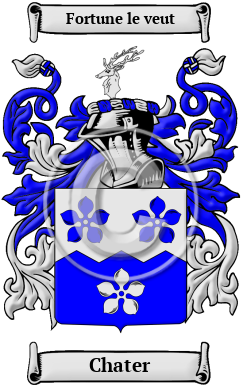
| ![Show Contents]() Chater History, Family Crest & Coats of Arms Chater History, Family Crest & Coats of Arms
- Origins Available:
England
Etymology of ChaterWhat does the name Chater mean? The name Chater arrived in England after the Norman Conquest of 1066. The Chater family lived in Bedfordshire. They were originally from Carteret Manche, Normandy, 1 having derived their name from the Ancient French word acatour, or acateor,which both mean "buyer" as in "buyer of provisions for a large household." 2 Other sources claim the name was "derived from the office of king's escheator-the person appointed to inquire into escheats, or property lapsing to the crown through want of heirs and other causes." 3 4 Early Origins of the Chater familyThe surname Chater was first found in Bedfordshire where William le CHatur was listed in the Curia Regis Rolls for 1220. A few years later in Cambridgeshire, Robert le Achatour was recorded in 1229 and later Amicia Lakature and Elias le Katur was listed there in 1271. Early Oxfordshire records show William le Catour, le Chatur, le Katour was listed at Balliol in 1310. 2 The Hundredorum Rolls of 1273 include an entry for Henry Escactor, Oxfordshire; Walter le Chatur, Cambridgeshire; and Agnes le Chatur, Cambridgeshire. 4 The source Testa de Nevill, sive Liber Feodorum, temp. Henry III-Edward I includes two entries: Ralph le Chatere, Warwickshire; and Stephen le Chatere, Warwickshire. 5. Early History of the Chater familyThis web page shows only a small excerpt of our Chater research. Another 128 words (9 lines of text) covering the years 1090, 1178, 1494, 1639, 1671, 1721, 1737 and 1801 are included under the topic Early Chater History in all our PDF Extended History products and printed products wherever possible. Chater Spelling VariationsAnglo-Norman names are characterized by a multitude of spelling variations. When the Normans became the ruling people of England in the 11th century, they introduced a new language into a society where the main languages of Old and later Middle English had no definite spelling rules. These languages were more often spoken than written, so they blended freely with one another. Contributing to this mixing of tongues was the fact that medieval scribes spelled words according to sound, ensuring that a person's name would appear differently in nearly every document in which it was recorded. The name has been spelled Chaytor, Chater, Chaters, Chator, Chators and others. Early Notables of the Chater familyAnother 40 words (3 lines of text) are included under the topic Early Chater Notables in all our PDF Extended History products and printed products wherever possible.
| Chater migration to the United States | + |
For many English families, the political and religious disarray that plagued their homeland made the frontiers of the New World an attractive prospect. Thousands migrated, aboard cramped disease-ridden ships. They arrived sick, poor, and hungry, but were welcomed in many cases with far greater opportunity than at home in England. Many of these hardy settlers went on to make important contributions to the emerging nations in which they landed. Among early immigrants bearing the name Chater or a variant listed above were:
Chater Settlers in United States in the 19th Century- A Chater, who arrived in San Francisco, California in 1850 6
| Chater migration to Australia | + |
Chater Settlers in Australia in the 19th Century- Emily Chater, aged 16, a housemaid, who arrived in South Australia in 1859 aboard the ship "Clara"
| Chater migration to West Indies | + |
The British first settled the British West Indies around 1604. They made many attempts but failed in some to establish settlements on the Islands including Saint Lucia and Grenada. By 1627 they had managed to establish settlements on St. Kitts (St. Christopher) and Barbados, but by 1641 the Spanish had moved in and destroyed some of these including those at Providence Island. The British continued to expand the settlements including setting the First Federation in the British West Indies by 1674; some of the islands include Barbados, Bermuda, Cayman Island, Turks and Caicos, Jamaica and Belize then known as British Honduras. By the 1960's many of the islands became independent after the West Indies Federation which existed from 1958 to 1962 failed due to internal political conflicts. After this a number of Eastern Caribbean islands formed a free association. 7Chater Settlers in West Indies in the 17th Century- Jo Chater, aged 17, who landed in Barbados in 1635 6
- Mr. John Chater, (b. 1618), aged 17, British settler travelling aboard the ship "Expedition" arriving in Barbados in 1636 8
| Contemporary Notables of the name Chater (post 1700) | + |
- Veronica Chater, American author and memoirist
- Shirley Sears Chater (b. 1932), American nurse, educational administrator and government official
- Daniel Chater, American politician, U.S. Vice Consul in Windsor, 1916-17 9
- Hilda Florence Chater (1874-1968), English and Irish chess player, she was the four-time Irish Women's Chess Championship winner
- John W Chater (1840-1885), English publisher in Tyneside in the late 1800s
- Geoffrey Michael Chater Robinson (1921-2021), English stage, television and film actor, known for crime drama and detectives series such as Foyle's War and Midsomer Murders
- Gordon Maitland Chater (1922-1999), English-born, Australian Gold Logie Award winning comedian and actor
- James Chater (b. 1951), British composer and musicologist, he studied music at the University of Oxford
- Eos Chater (b. 1976), later Counsell, Welsh violinist for the Australian-British string quartet Bond
- ... (Another 10 notables are available in all our PDF Extended History products and printed products wherever possible.)
The motto was originally a war cry or slogan. Mottoes first began to be shown with arms in the 14th and 15th centuries, but were not in general use until the 17th century. Thus the oldest coats of arms generally do not include a motto. Mottoes seldom form part of the grant of arms: Under most heraldic authorities, a motto is an optional component of the coat of arms, and can be added to or changed at will; many families have chosen not to display a motto.
Motto: Fortune le veut
Motto Translation: Fortune so wills it.
- The Norman People and Their Existing Descendants in the British Dominions and the United States Of America. Baltimore: Genealogical Publishing, 1975. Print. (ISBN 0-8063-0636-X)
- Reaney, P.H and R.M. Wilson, A Dictionary of English Surnames. London: Routledge, 1991. Print. (ISBN 0-415-05737-X)
- Lower, Mark Anthony, Patronymica Britannica, A Dictionary of Family Names of the United Kingdom. London: John Russel Smith, 1860. Print.
- Bardsley, C.W, A Dictionary of English and Welsh Surnames: With Special American Instances. Wiltshire: Heraldry Today, 1901. Print. (ISBN 0-900455-44-6)
- Testa de Nevill or "Liber Feodorum" or "Book of Fees," thought to have been written by Ralph de Nevill, for King John (1199–1216)
- Filby, P. William, Meyer, Mary K., Passenger and immigration lists index : a guide to published arrival records of about 500,000 passengers who came to the United States and Canada in the seventeenth, eighteenth, and nineteenth centuries. 1982-1985 Cumulated Supplements in Four Volumes Detroit, Mich. : Gale Research Co., 1985, Print (ISBN 0-8103-1795-8)
- https://en.wikipedia.org/wiki/British_West_Indies
- Pilgrim Ship Lists Early 1600's retrieved 29th September 2021. Retrieved from https://www.packrat-pro.com/ships/shiplist.htm
- The Political Graveyard: Alphabetical Name Index. (Retrieved 2015, December 8) . Retrieved from http://politicalgraveyard.com/alpha/index.html
 |