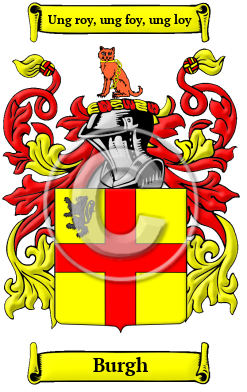
| ![Show Contents]() Burgh History, Family Crest & Coats of Arms Burgh History, Family Crest & Coats of Arms
Etymology of BurghWhat does the name Burgh mean? The surname is one of the Anglo-Norman names that came to Ireland in the 12th century. The surname Burgh is derived from the Old English word "burh," which is derived from the Old German word "burg," the common Germanic word for a fortification. It seems likely that the first family to bear this surname would have lived in or near a prehistoric fort situated on a hill. In the Norman fashion, surnames created from place names or geographic locations were prefixed by "de," which means "from" in French. Early Origins of the Burgh familyThe surname Burgh was first found in County Galway (Irish: Gaillimh) part of the province of Connacht, located on the west coast of the Island, where the family name is descended from the Norman noble William Fitzadelm de Burgo who went to Ireland in the Anglo-Norman invasion of Ireland and was the succeeded Strongbow as Chief Governor. "Robert de Burgh, Earl of Moreton in Normandy, son of Harlowen de Burgh, by Arlotta, his wife, mother of William the Conqueror, participated with his half-brother in the triumph at Hastings, was created Earl of Cornwall, and received, as a further recompense, grants of seven hundred and ninety-three manors. His son, William Earl of Cornwall, who, rebelling against the Henry I., joined Robert of Normandy, and led the van at the battle of Tenchebray. He fell into the hands of his opponents and was sent prisoner to England, where he was treated with much cruelty, and detaining him in captivity for life. He left two sons: I. Adelm, from whom descended the Burghs, Earls of Ulster, the noble House of Clanricarde, and the various families of Burke, so widely scattered over the south west district of Ireland; and II. John, whose son, Hubert de Burgh, Earl of Kent, was Justiciary of England, temp. Henry III., and one of the greatest subjects in England." 1 Great stretches of land were given to this family in the year 1177. Richard Oge de Burc, son of William, became the "Lord Justice of Ireland" under King Henry II in 1177 and was regranted the lands of his father the following year. (O'Hart) Richard Mor de Burc, the older son of William, was the ancestor of the family name Bourke or Burke. They formed several septs, the two most important having been the MacWilliam Uachtar sept of county Galway, and the MacWilliam Lochtar sept of county Mayo. It should be noted that not all of the family were in Ireland as some were found in Knaresborough, in the West Riding of Yorkshire in ancient times. "At the time of the Domesday Survey it formed part of the royal demesnes, and was given by the Conqueror to Serlo de Burgh, Baron of Tonsburg, in Normandy, who had accompanied that monarch into England, and by whom its stately castle, now a ruin, was originally built, on the rocky heights north of the river Nidd." 2 Another noted source confirms Knaresborough as a point of origin, but has a different Norman baron: " 'Burgh' must here stand for Serlo de Burgh, a powerful Northern Baron in the time of the Conqueror, who built Knaresborough Castle, and appears to have taken his name from the manor of Burgh, in Yorkshire. " 3 Early History of the Burgh familyThis web page shows only a small excerpt of our Burgh research. Another 140 words (10 lines of text) covering the years 1227, 1503, 1544, 1572, 1582, 1590, 1598, 1601, 1604, 1629, 1635, 1642, 1647, 1657, 1666, 1667, 1672 and 1722 are included under the topic Early Burgh History in all our PDF Extended History products and printed products wherever possible. Burgh Spelling VariationsSince church officials and medieval scribes spelt each name as it sounded to them; as a result, a single person could accumulate many different versions of his name within official records. A close examination of the origins of the name Burgh revealed the following spelling variations: de Burgh, Burke, Bourke, Burk, Bourk, Gillick and many more. Early Notables of the Burgh family- The Most Reverend John de Burgh (de Burgo, Burke) (1590-1667), an Irish Roman Catholic clergyman, Vicar Apostolic and Bishop of Clonfert (1629 to 1647) and Archbishop of Tuam (1647 to 1667)
| Burgh migration to the United States | + |
During the middle of the 19th century, Irish families often experienced extreme poverty and racial discrimination in their own homeland under English rule. Record numbers died of disease and starvation and many others, deciding against such a fate, boarded ships bound for North America. The largest influx of Irish settlers occurred with Great Potato Famine of the late 1840s. Unfortunately, many of those Irish that arrived in Canada or the United States still experienced economic and racial discrimination. Although often maligned, these Irish people were essential to the rapid development of these countries because they provided the cheap labor required for the many canals, roads, railways, and other projects required for strong national infrastructures. Eventually the Irish went on to make contributions in the less backbreaking and more intellectual arenas of commerce, education, and the arts. Research early immigration and passenger lists revealed many early immigrants bearing the name Burgh:
Burgh Settlers in United States in the 18th Century- John Burgh, who arrived in Virginia in 1705 4
Burgh Settlers in United States in the 19th Century- Samuel Burgh, aged 22, British settler who arrived in New York aboard the ship "Princess Charlotte" in 1830 5
- J. Burgh, aged 47, British settler who arrived in New York aboard the ship "Hudson" in 1832 5
- Francis Burgh, aged 34, British settler who arrived in New York aboard the ship "Philadelphia" in 1840 5
- George Burgh, aged 7, British settler who arrived in New York aboard the ship "Philadelphia" in 1840 5
- Sarah Burgh, aged 28, British settler who arrived in New York aboard the ship "Jane" in 1840 5
- ... (More are available in all our PDF Extended History products and printed products wherever possible.)
| Burgh migration to Australia | + |
Burgh Settlers in Australia in the 19th Century- Miss Eliza Burgh, (b. 1816), aged 25, British house maid who was convicted in Gloucestershire, England for 10 years for house breaking, transported aboard the "Garland Grove" on 14th June 1841, arriving in Tasmania (Van Diemen's Land) 6
- Eliza Burgh, aged 40, who arrived in South Australia in 1849 aboard the ship "William Money" 7
- Miss Letitia Burgh (Bird), (b. 1830), aged 20, English nursemaid, from Essex travelling from London aboard the ship "Slains Castle" arriving in Melbourne, Victoria, Australia on 25th January 1851 8
Burgh Settlers in Australia in the 20th Century- L. Burgh, British settler who arrived in Fremantle, Australia aboard the ship "Ophir" in 1909
- Vander Burgh, settler who arrived in Western Australia aboard the ship "Malwa" in 1913
- Miss Annette E. Burgh, British settler who arrived in Fremantle, Australia aboard the ship "Chitral" in 1928
| Contemporary Notables of the name Burgh (post 1700) | + |
- Ulick Canning de Burgh (1827-1867), Lord Dunkellin, Anglo-Irish soldier and politician, was Military Secretary to the Viceroy of India and MP for Galway Borough (1857-65) and County Galway (1865-67)
- Walter de Burgh (1210-1271), 1st Earl of Ulster, 2nd Lord of Connaught, also spelt Burke or Bourke, Irish peer from the House of Burgh
- Sir William Óg de Burgh (b. 1270), Anglo-Irish noble and soldier
- William de Burgh (1312-1333), 3rd Earl of Ulster and 4th Baron of Connaught, Irish noble who was Lieutenant of Ireland (1331)
- William de Burgh (1741-1808), prominent Anglo-Irish politician and theological writer and politician
- William Edward de Burgh (1863-1902), Irish clergman
- Margery de Burgh (1224-1252), Norman-Irish noblewoman
- Richard Óg de Burgh (1240-1326), 2nd Earl of Ulster and 3rd Baron of Connaught, called The Red Earl, was one of the most powerful Irish nobles of the late 13th and early 14th centuries
- Colonel Thomas de Burgh (1670-1730), also known as Thomas Burgh, Anglo-Irish military engineer, architect, and politican
- ... (Another 40 notables are available in all our PDF Extended History products and printed products wherever possible.)
The motto was originally a war cry or slogan. Mottoes first began to be shown with arms in the 14th and 15th centuries, but were not in general use until the 17th century. Thus the oldest coats of arms generally do not include a motto. Mottoes seldom form part of the grant of arms: Under most heraldic authorities, a motto is an optional component of the coat of arms, and can be added to or changed at will; many families have chosen not to display a motto.
Motto: Ung roy, ung foy, ung loy
Motto Translation: One king, one faith, one law.
- Burke, John Bernard, The Roll of Battle Abbey. London: Edward Churton, 26, Holles Street, 1848, Print.
- Lewis, Samuel, A Topographical Dictionary of England. Institute of Historical Research, 1848, Print.
- Cleveland, Dutchess of The Battle Abbey Roll with some Account of the Norman Lineages. London: John Murray, Abermarle Street, 1889. Print. Volume 1 of 3
- Filby, P. William, Meyer, Mary K., Passenger and immigration lists index : a guide to published arrival records of about 500,000 passengers who came to the United States and Canada in the seventeenth, eighteenth, and nineteenth centuries. 1982-1985 Cumulated Supplements in Four Volumes Detroit, Mich. : Gale Research Co., 1985, Print (ISBN 0-8103-1795-8)
- Ellis Island Search retrieved 21st October 2021. Retrieved from https://heritage.statueofliberty.org/passenger-result
- Convict Records Voyages to Australia (Retrieved 24th October 2022). https://convictrecords.com.au
- State Records of South Australia. (Retrieved 2010, November 5) "WILLIAM MONEY" 1848-49. Retrieved from http://www.slsa.sa.gov.au/BSA/1849WmMoney.htm
- The Argus News Paper 27th January 1852 Page 2 (Retrieved 26th April 2019). Retrieved from https://trove.nla.gov.au/newspaper/article/4775844?browse=ndp%3Abrowse%2Ftitle%2FA%2Ftitle%2F13%2F1851%2F01%2F27%2Fpage%2F505154%2Farticle%2F4775844
 |