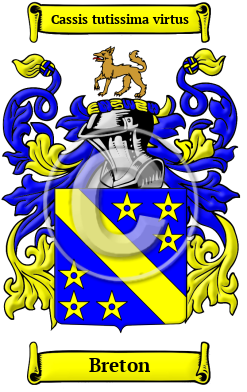
| ![Show Contents]() Breton History, Family Crest & Coats of Arms Breton History, Family Crest & Coats of Arms
Etymology of BretonWhat does the name Breton mean? Breton is a name whose history on English soil dates back to the wave of migration that followed the Norman Conquest of England of 1066. The Breton family lived in Essex. The name is a reference to the French province of Brettagne or Brittany. Families from this area largely consisted of the descendants of Celtic tribes who were originally forced to flee ancient Britain from the Roman Tyrant, Maximus, around 384 AD, and settled across the Channel. When the Romans left, the settlement remained, and carries the name to this day. From about 950 onwards, the Dukes of Brittany became closely related to the Dukes of Normandy, and even accompanied them at Hastings in 1066. Many of the Brettagne families who were granted land by William, Duke of Normandy had come in a complete circle, settling again on their former homeland in Powys, on the English-Welsh border. Early Origins of the Breton familyThe surname Breton was first found in the Domesday Book of 1086 where "no less than nine of this name appear: all of them probably Breton knights that had followed the fortunes of Alain-le-Roux or his kinsmen. Alured Brito held of the King a barony of twenty-two lordships in Devonshire: Gozelin another in Bucks, Gloucester, and Bedfordshire; Oger one in Leicester and Lincoln; Rainald one in Sussex; Tihel one in Essex and Norfolk; Waldeve one in Lincoln and Cheshire; and Maigno or Manno Brito one in Bucks and Leicestershire. Two others, Roger and William, were mesne-lords in Somerset and Huntingdon." 1 "The manor of Kenardington [in Kent] formed a portion of the lands assigned by William the Conqueror for the defence of Dover Castle, and came by marriage in the reign of George I. to the Breton family, with whom it has since remained. " 2 The name occurred many times throughout the Hundredorum Rolls of 1273: John de Brytaygn in Cambridgeshire; Giffard le Bretun in Buckinghamshire; Hugo le Bretun in Suffolk and more. The Yorkshire Poll Tax Rolls of 1379 listed Alicia de Britten; Elias de Britton; and Ricardus Britton. 3 John le Breton (d. 1275), was Bishop of Hereford and was chosen bishop about Christmas 1268, being then a canon of Hereford, and was consecrated 2 June 1269. For about two years before this he was a justice of the king's court. He died 12 May 1275. 4 Ranulph Brito or Le Breton (d. 1246), was Canon of St. Paul's and is first mentioned in the year 1221 as a chaplain of Hubert de Burgh. "During the administration of his patron he stood high in the favour of Henry III, and became the king's treasurer. " 4 William Briton or Breton (d. 1356), was an early English "theologian, described as a Franciscan by all the literary biographers. No fact is known of his life." 4 Early records of Warwickshire also found the family in the hamlet of Marston. "This place, anciently called Breton's Mannour, was held by Guido Breton in the reign of Henry IV.; the manor has since gone with that of Wolstan." 2 John Brettan or Breton (died after 1382) was an Irish judge and Crown official. His family is generally thought to have arrived in Ireland in the 1170s with the Strongbow invasion. Early History of the Breton familyThis web page shows only a small excerpt of our Breton research. Another 322 words (23 lines of text) covering the years 1066, 1164, 1273, 1275, 1295, 1296, 1499, 1545, 1607, 1618 and 1626 are included under the topic Early Breton History in all our PDF Extended History products and printed products wherever possible. Breton Spelling VariationsA multitude of spelling variations characterize Norman surnames. Many variations occurred because Old and Middle English lacked any definite spelling rules. The introduction of Norman French to England also had a pronounced effect, as did the court languages of Latin and French. Therefore, one person was often referred to by several different spellings in a single lifetime. The various spellings include Breton, Britain, Britayne, Briton, Brittain, Brittaine, Brittan, Britten, Brittenie, Brittin, Britting, Britton, Brittone, Brettain, Bretaine, Bretayne, Brettin, Bretin, Brettan, Brettinie, Brettony, Brittany, Brettany, Britteny, Brittiny and many more. Early Notables of the Breton family- John de Breton (died 1275), medieval Bishop of Hereford, royal justice and sheriff, generally attributed to the term "Britton," the earliest summary of the law of England, written in French; and Nicho...
Breton World Rankingthe United States, the name Breton is the 5,885th most popular surname with an estimated 4,974 people with that name. 5 However, in Canada, the name Breton is ranked the 398th most popular surname with an estimated 11,649 people with that name. 6 And in Quebec, Canada, the name Breton is the 136th popular surname. 7 France ranks Breton as 143rd with 21,620 people. 8 Migration of the Breton family to IrelandSome of the Breton family moved to Ireland, but this topic is not covered in this excerpt.
Another 35 words (2 lines of text) about their life in Ireland is included in all our PDF Extended History products and printed products wherever possible.
| Breton migration to the United States | + |
Many English families left England, to avoid the chaos of their homeland and migrated to the many British colonies abroad. Although the conditions on the ships were extremely cramped, and some travelers arrived diseased, starving, and destitute, once in the colonies, many of the families prospered and made valuable contributions to the cultures of what would become the United States and Canada. Research into the origins of individual families in North America has revealed records of the immigration of a number of people bearing the name Breton or a variant listed above:
Breton Settlers in United States in the 18th Century- Mrs. Breton, aged 53, who arrived in South Carolina in 1732 9
- Widow Breton, aged 53, who settled with her son Jean Pierre Breton, aged 17, in Charles Town in 1732
Breton Settlers in United States in the 19th Century- J. Breton, aged 32, settled in New Orleans in 1820
- Elizabeth Breton, aged 28, who settled in New York in 1820
- James Breton, aged 60, settled in New Orleans in 1820
- Rodrigo Breton, who arrived in Cartagena in 1834 9
- Anton Breton, who arrived in New Spain in 1835 9
- ... (More are available in all our PDF Extended History products and printed products wherever possible.)
| Breton migration to Canada | + |
Breton Settlers in Canada in the 17th Century- Le Petit Breton, who landed in Montreal in 1660
- René Breton, son of Mathieu and Michelle, who married Charlotte De Chavigny, daughter of François and Éléonore, in Quebec on 6th November 1668 10
- François Breton, son of Jean and Marie, who married Barbe Dumont, daughter of André and Catherine, in Quebec on 11th November 1668 10
- Jean Breton, son of Jean and Marthe, who married Marie Crête, daughter of Jean and Marguerite, in Quebec on 21st April 1687 10
Breton Settlers in Canada in the 18th Century- Jean-Hilaire Breton, son of Jean and Marie, who married Marie-Josephte Paquet, daughter of Pierre and Marie, in Quebec on 3rd September 1716 10
- Jacques Breton, son of Nicolas and Marie, who married Marie-Catherine Vernas, daughter of Louis and Marie-Charlotte, in Saint-Augustin, Quebec on 23rd April 1731 10
- Jean-Charles Breton, son of Nicolas and Catherine, who married Marguerite Léger, daughter of Jean and Marguerite, in Quebec on 16th November 1750 10
- Louis Breton, son of Jean-Hilaire and Marie-Josephte, who married Marie-Thérèse Thomas, daughter of Jacques and Thérèse, in Charlesbourg, Quebec on 5th July 1756 10
- Samuel Breton, who landed in Nova Scotia in 1761
- ... (More are available in all our PDF Extended History products and printed products wherever possible.)
| Contemporary Notables of the name Breton (post 1700) | + |
- Leonello Breton (1904-1979), American Democratic Party politician, Delegate to New Hampshire State Constitutional Convention from Manchester 8th Ward, 1956; Treasurer of New Hampshire Democratic Party, 1957 11
- Nicholas Breton (1545-1626), English poet
- Philippe Louis Jean Breton (1936-2020), French Roman Catholic Bishop of Aire et Dax (2002–2012)
- Jean-Baptiste Breton, French Brigadier General during the French Revolutionary and Napoleonic Wars from 1789 to 1815 12
- Henry Hugh Breton (1873-1936), Anglican clergyman and author
- John Glossop Bythesea Le Breton (1884-1968), Soldier and Author
- Jules Adolphe Aimé Louis Breton, French painter
- Thierry Breton (b. 1955), French executive, Chairman and CEO of France Télécom
- André Breton (1896-1966), French poet and literary theorist
The motto was originally a war cry or slogan. Mottoes first began to be shown with arms in the 14th and 15th centuries, but were not in general use until the 17th century. Thus the oldest coats of arms generally do not include a motto. Mottoes seldom form part of the grant of arms: Under most heraldic authorities, a motto is an optional component of the coat of arms, and can be added to or changed at will; many families have chosen not to display a motto.
Motto: Cassis tutissima virtus
Motto Translation: Virtue is the safest helmet.
- Cleveland, Dutchess of The Battle Abbey Roll with some Account of the Norman Lineages. London: John Murray, Abermarle Street, 1889. Print. Volume 1 of 3
- Lewis, Samuel, A Topographical Dictionary of England. Institute of Historical Research, 1848, Print.
- Bardsley, C.W, A Dictionary of English and Welsh Surnames: With Special American Instances. Wiltshire: Heraldry Today, 1901. Print. (ISBN 0-900455-44-6)
- Smith, George (ed), Dictionary of National Biography. London: Smith, Elder & Co., 1885-1900. Print
- "What are the 5,000 Most Common Last Names in the U.S.?". NameCensus.com, https://namecensus.com/last-names/
- "Surnames Meanings, Origins & Distribution Maps - Forebears." Forebears, https://forebears.io/surnames
- "The first 1,000 family names by rank, Quebec (in French only)" Institut de la statistique du Quebec, https://statistique.quebec.ca/en/document/family-names-in-quebec/tableau/the-first-1000-family-names-by-rank-quebec
- http://www.journaldesfemmes.com/nom-de-famille/nom/
- Filby, P. William, Meyer, Mary K., Passenger and immigration lists index : a guide to published arrival records of about 500,000 passengers who came to the United States and Canada in the seventeenth, eighteenth, and nineteenth centuries. 1982-1985 Cumulated Supplements in Four Volumes Detroit, Mich. : Gale Research Co., 1985, Print (ISBN 0-8103-1795-8)
- Internoscia, Arthur E., and Claire Chevrier. Dictionnaire National des Canadiens Français 1608-1760. Vol. 1, Institut Drouin, 1958.
- The Political Graveyard: Alphabetical Name Index. (Retrieved 2015, November 25) . Retrieved from http://politicalgraveyard.com/alpha/index.html
- Generals Who Served in the French Army during the Period 1789-1815. (Retrieved 2015, February 11) Jean-Baptiste Breton. Retrieved from http://www.napoleon-series.org/research/c_frenchgenerals.html
 |