| ![Show Contents]() Blount History, Family Crest & Coats of Arms Blount History, Family Crest & Coats of Arms
Etymology of BlountWhat does the name Blount mean? The Blount family has descended through the lines of the ancient Normans that came to England following their Conquest of England in 1066. The Blount name reveals that an early member was a person with blond hair having derived from the Anglo-Norman French word blunt, which means blond. 1 Early Origins of the Blount familyThe surname Blount was first found in Suffolk where the Blounts or Blunts, as they are more modernly called, trace their heritage to the Normans, specifically to Rudolph, Count of Guisnes, who nobly assisted Duke William of Normandy to conquer the Saxons at Hastings, in 1066. Sir Robert de Blount (c.1029-1066) had command of the Conqueror's ships during the invasion and was amply rewarded. Sir William, his brother, commanded his foot soldiers at Hastings. 2 These two great nobles received lands in Suffolk, Sir Robert became Baron of Ixworth, Lord of Orford Castle, and Sir William got seven lordships at Saxlingham in the county of Sussex. Each of these branches flourished and there is a record of each succeeding Baron in each estate. Both are recorded in the Domesday Book with their various properties. 3 John de Blund or Blunt (c. 1175-1248), Chancellor of York, was one of the leaders of the movement for the restoration of the University of Oxford to its ancient position as a seat of learning. He was Archbishop of Canterbury-elect in 1232. 4 Stephen le Blount (Blund) (fl. 1320s), was an English Member of Parliament for Lichfield (1326-1327.) In Scotland, the name is more often than not a variant of Blund. John le Blunt of Eskeby from Dumfriesshire, rendered homage to King Edward I of England in 1296. Interestingly, Hugh de Abirbuthenoth, who gifted the church of Garuoch to the monastery of Arnbroath in 1292, was commonly designated Hugo Blundus or Le Blond, from the flaxen color of his hair. However, the first record in Scotland was sometime before 1200 when Rodbert Blundus witnessed a charier by Roger de Quenci. Later Adam Blundus witnessed a confirmation charter by the Chapter of Brechin c. 1212-1218. John Blund who witnessed a charter by Matilda, countess of Angus, c. 1242-1248 is probably the John Blundus who appears as a charter witness in Brechin in 1267. 5 Back in England, the Hundredorum Rolls of 1273 included listings of: Melodia le Blount, Huntingdonshire; Margareta le Blound, Cambridgeshire; Richard le Blont, Wiltshire; Alan le Blund, Oxfordshire; and Richard le Blunt, Wiltshire. 6 Ascelina le Blund, or Blunt was listed in Norfolk in 1272 7 and John le Blont, was listed in Somerset, 1 Edward III (during the first year of Edward III's reign.) 8 The Yorkshire Poll Tax Rolls of 1379 included: Johannes Blont; and Ricardus Blont. 6 Robert de Houton was rector of the church of St. Elphin, Warrington, Lancashire and was confirmed the 3rd of April 1330. 9 Early History of the Blount familyThis web page shows only a small excerpt of our Blount research. Another 197 words (14 lines of text) covering the years 1400, 1403, 1493, 1502, 1529, 1540, 1563, 1565, 1580, 1594, 1597, 1600, 1601, 1604, 1606, 1617, 1618, 1624, 1632, 1640, 1649, 1654, 1666, 1670, 1679, 1693, 1697 and 1731 are included under the topic Early Blount History in all our PDF Extended History products and printed products wherever possible. Blount Spelling VariationsBefore the advent of the printing press and the first dictionaries, the English language was not standardized. Sound was what guided spelling in the Middle Ages, so one person's name was often recorded under several variations during a single lifetime. Spelling variations were common, even among the names of the most literate people. Known variations of the Blount family name include Blount, Blunt, Blond, Blonde, Blund and others. Early Notables of the Blount family- Sir Thomas Blount (d. 1400), supporter of Richard II; Sir Walter Blount (died 1403), soldier and supporter of John of Gaunt (Duke of Lancaster), served as the royal standard bearer, mistaken for the k...
Blount RankingIn the United States, the name Blount is the 1,462nd most popular surname with an estimated 19,896 people with that name. 10 Migration of the Blount family to IrelandSome of the Blount family moved to Ireland, but this topic is not covered in this excerpt.
Another 45 words (3 lines of text) about their life in Ireland is included in all our PDF Extended History products and printed products wherever possible.
| Blount migration to the United States | + |
To escape the political and religious chaos of this era, thousands of English families began to migrate to the New World in search of land and freedom from religious and political persecution. The passage was expensive and the ships were dark, crowded, and unsafe; however, those who made the voyage safely were encountered opportunities that were not available to them in their homeland. Many of the families that reached the New World at this time went on to make important contributions to the emerging nations of the United States and Canada. Research into various historical records has revealed some of first members of the Blount family to immigrate North America:
Blount Settlers in United States in the 17th Century- James Blount, who landed in Virginia in 1655 12
- John Blount who settled in North Carolina in 1675
- Thomas Blount, who arrived in North Carolina in 1695
Blount Settlers in United States in the 18th Century- Nathaniel Blount, who arrived in North Carolina in 1773 12
- John Blount, who settled in Maryland in 1775
- Stephen Blount, who arrived in Mississippi in 1798 12
Blount Settlers in United States in the 19th Century- Benjamin Blount, aged 1, British settler who arrived in New York aboard the ship "Richmond" in 1820 13
- Job Blount, aged 2, British settler who arrived in New York aboard the ship "Richmond" in 1820 13
- Job Blount, aged 2, British settler who arrived in New York aboard the ship "Richmond" in 1820 13
- Ann Blount, aged 6, British settler who arrived in New York aboard the ship "Richmond" in 1820 13
- Mr. Blount, who arrived in Mobile, Ala in 1822 12
- ... (More are available in all our PDF Extended History products and printed products wherever possible.)
| Blount migration to Australia | + |
Emigration to Australia included the First Fleet of convicts, tradespeople and early settlers. Early immigrants include: First Fleet - Mr. William Blount, (Brunt), (b. 1741), aged 48, British labourer convicted in Herefordshire, England in 1788, sentenced to Life for theft, transported aboard the ship "Neptune" leaving in 1789 arriving in New South Wales, Australia in 1790, may have died on the ship 11
Following the First Fleet, other convicts and early settlers arriving in Australia include: Blount Settlers in Australia in the 19th Century- Mr. Humphrey Blount, English convict who was convicted in Worcester, Worcestershire, England for life, transported aboard the "Atlas" on 16th January 1816, arriving in New South Wales, Australia 14
- Mr. William Blount, English convict who was convicted in Warwick, Warwickshire, England for 14 years, transported aboard the "Dromedary" on 11th September 1819, arriving in Tasmania (Van Diemen's Land) 15
- Mr. William John Blount, English convict who was convicted in Leicester, Leicestershire, England for 7 years, transported aboard the "Fairlie" on 9th Mary 1852, arriving in Tasmania (Van Diemen's Island) 16
- Patrick Blount, aged 20, who arrived in South Australia in 1859 aboard the ship "Lady Ann"
Blount Settlers in Australia in the 20th Century- Ed Blount, settler who arrived in Fremantle, Australia aboard the ship "Bremen" in 1910 17
- Bertram Blount, settler who arrived in Melbourne, Australia aboard the ship "Osterley" in 1911 17
- E. Blount, settler who arrived in Fremantle, Australia aboard the ship "Kanowna" in 1917 17
- Constance M. Blount, settler who arrived in Sydney, Australia aboard the ship "Themistocles" in 1933 17
- Henry G. Blount, settler who arrived in Sydney, Australia aboard the ship "Themistocles" in 1933 17
- ... (More are available in all our PDF Extended History products and printed products wherever possible.)
| Contemporary Notables of the name Blount (post 1700) | + |
- James Hillier Blount (b. 1974), better known as James Blunt, is an English five-time Grammy Award nominated singer, songwriter, musician, and record producer; hi first album has sold over 11 million copies worldwide
- James L. "Jim" Blount (1935-2017), American newspaper editor of the Hamilton Journal-News
- Mark D. Blount (b. 1975), American retired professional NBA basketball player
- Lisa S. Blount (1957-2010), American film and television actress and Academy Award winning producer
- James Henderson Blount (1837-1903), American statesman, soldier and politician, Member of the U.S. House of Representatives from Georgia (1873-1893)
- Melvin Cornell "Mel" Blount (b. 1948), American former Pittsburgh Steelers cornerback, five-time Pro Bowler and Pro Football Hall of Fame inductee, founder of the Mel Blount Youth Home
- Brigadier-General Roy Eugene Blount (1889-1969), American Commanding General Army Port & Service Command US Central Pacific Theater of Operations (1943-1945) 18
- LeGarrette Montez Blount (b. 1986), American NFL football running back
- Willie Blount (1768-1835), American politician, 3rd Governor of Tennessee (1809-1815)
- ... (Another 49 notables are available in all our PDF Extended History products and printed products wherever possible.)
| Historic Events for the Blount family | + |
- Mr. Wayman Boney Blount, American Seaman First Class from Texas, USA working aboard the ship "USS Arizona" when she sunk during the Japanese attack on Pearl Harbor on 7th December 1941, he died in the sinking 19
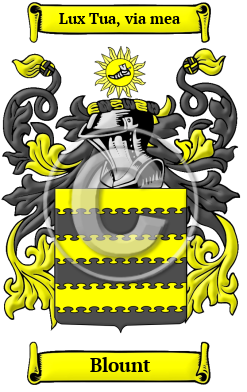
The motto was originally a war cry or slogan. Mottoes first began to be shown with arms in the 14th and 15th centuries, but were not in general use until the 17th century. Thus the oldest coats of arms generally do not include a motto. Mottoes seldom form part of the grant of arms: Under most heraldic authorities, a motto is an optional component of the coat of arms, and can be added to or changed at will; many families have chosen not to display a motto.
Motto: Lux Tua, via mea
Motto Translation: Thy light is my way.
| Suggested Readings for the name Blount | + |
- Reminiscences and Memoirs of North Carolina and Eminent North Carolinians by John Hill Wheeler.
- Parker and Blount in Florida by Virginia Westergard.
- Smith, Eldson Coles, New Dictionary of American Family Names New York: Harper & Row, 1956. Print
- Burke, John Bernard, The Roll of Battle Abbey. London: Edward Churton, 26, Holles Street, 1848, Print.
- Cleveland, Dutchess of The Battle Abbey Roll with some Account of the Norman Lineages. London: John Murray, Abermarle Street, 1889. Print. Volume 1 of 3
- Smith, George (ed), Dictionary of National Biography. London: Smith, Elder & Co., 1885-1900. Print
- Black, George F., The Surnames of Scotland Their Origin, Meaning and History. New York: New York Public Library, 1946. Print. (ISBN 0-87104-172-3)
- Bardsley, C.W, A Dictionary of English and Welsh Surnames: With Special American Instances. Wiltshire: Heraldry Today, 1901. Print. (ISBN 0-900455-44-6)
- Rye, Walter, A History of Norfolk. London: Elliot Stock, 62, Paternoster Row, 1885. Print
- Dickinson, F.H., Kirby's Quest for Somerset of 16th of Edward the 3rd London: Harrison and Sons, Printers in Ordinary to Her Majesty, St, Martin's Lane, 1889. Print.
- 'Townships: Scarisbrick', in A History of the County of Lancaster: Volume 3, ed. William Farrer and J Brownbill (London, 1907), pp. 265-276. British History Online http://www.british-history.ac.uk/vch/lancs/vol3/pp265-276 [accessed 21 January 2017].
- "What are the 5,000 Most Common Last Names in the U.S.?". NameCensus.com, https://namecensus.com/last-names/
- Convict Records of Australia. Retrieved 4th February 2021 from https://convictrecords.com.au/ships
- Filby, P. William, Meyer, Mary K., Passenger and immigration lists index : a guide to published arrival records of about 500,000 passengers who came to the United States and Canada in the seventeenth, eighteenth, and nineteenth centuries. 1982-1985 Cumulated Supplements in Four Volumes Detroit, Mich. : Gale Research Co., 1985, Print (ISBN 0-8103-1795-8)
- Ellis Island Search retrieved 15th November 2022. Retrieved from https://heritage.statueofliberty.org/passenger-result
- Convict Records Voyages to Australia (Retrieved 14th July 2020). Retrieved from https://convictrecords.com.au/ships/atlas
- Convict Records Voyages to Australia (Retrieved 16th July 2021). Retrieved from https://convictrecords.com.au/ships/dromedary
- Convict Records Voyages to Australia (Retrieved 26th September 2022). https://convictrecords.com.au/ships/fairlie
- National Archives of Australia retrieved 15th November 2022. Retrieved from https://recordsearch.naa.gov.au/SearchNRetrieve/Interface/ListingReports/PassengerListing.aspx
- Generals of World War II. (Retrieved 2011, October 22) Roy Blount. Retrieved from http://generals.dk/general/Blount/Roy_Eugene/USA.html
- Pearl Harbour: USS Arizona Casualties List Pearl Harbour December 7, 1941. (Retrieved 2018, July 31st). Retrieved from http://pearl-harbor.com/arizona/casualtylist.html
 |