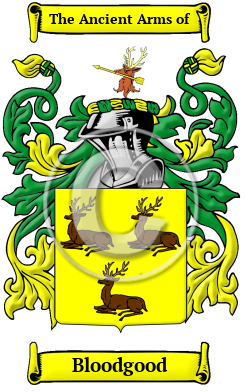
| ![Show Contents]() Bloodgood History, Family Crest & Coats of Arms Bloodgood History, Family Crest & Coats of Arms
The surname Bloodgood is a Welsh name of old Celtic origin. The surname is from the well-known Welsh personal name Lloyd. The surname Bloodgood features the distinctive Welsh patronymic prefix "ab-" which means "son of." The original form of the name was "Ab-Lloyd," which evolved into "Ap-Llud" and then "Blud." 1 Early Origins of the Bloodgood familyThe surname Bloodgood was first found in Cardiganshire (Welsh: Sir Aberteifi), the former Kingdom of Ceredigion, created as a county in 1282 by Edward I, and located on the West coast of Wales, where they held a family seat from ancient times. They are descended from the Lloyds of Cardigan,_Ceredigion' target='_blank'>Cardigan Castle. Early History of the Bloodgood familyThis web page shows only a small excerpt of our Bloodgood research. Another 86 words (6 lines of text) covering the years 1595, 1600, 1613, 1618, 1660, 1661, 1671, 1672, 1680, 1688 and 1707 are included under the topic Early Bloodgood History in all our PDF Extended History products and printed products wherever possible. Bloodgood Spelling VariationsThe Welsh have an extremely large amount of spelling variations of their native surnames to their credit. It was up to the priest or the scribe taking the official records to determine how the spoken name was to be made literal. As time progressed, the old Brythonic names of Wales were recorded in English, which was especially problematic since the English language had extreme difficulty recording the highly inflected sounds of Cymraeg. Spelling variations were, however, also carried out according to an individual's design: a branch loyalty within the family, a religious adherence, or even patriotic affiliations could be indicated by spelling variations of one's name. The spelling variations of the name Bloodgood have included Blood, Bloode, Blud, Bludd and others. Early Notables of the Bloodgood familyProminent amongst the family during the late Middle Ages was Colonel Thomas Blood (1618-1680), a "noted bravo and desperado", an Irish-born colonel best known for attempting to steal the Crown Jewels of England from the Tower of London in 1671. He died on Tuesday, 24 Aug. 1680. He was buried on the 26th, at Tothill Fields. Rumours being afloat that it had been a sham funeral, to keep the living man hidden elsewhere, his body was exhumed on the following Thursday, and identified at...
Another 83 words (6 lines of text) are included under the topic Early Bloodgood Notables in all our PDF Extended History products and printed products wherever possible.  Migration of the Bloodgood family to Ireland Migration of the Bloodgood family to Ireland
Some of the Bloodgood family moved to Ireland, but this topic is not covered in this excerpt.
Another 143 words (10 lines of text) about their life in Ireland is included in all our PDF Extended History products and printed products wherever possible.
| Bloodgood migration to the United States | + |
During the latter half of the 19th and the beginning of the 20th century, the people of Wales journeyed to North America to find a new life. They made major contributions to the arts, industry and commerce of both Canada and the United States, and added a rich cultural heritage to their newly adopted societies. A look at the immigration and passenger lists has shown a number of people bearing the name Bloodgood:
Bloodgood Settlers in United States in the 17th Century- Frans Jans Bloodgood, who landed in New Netherland(s) in 1620 2
- Frans Jansen Bloodgood, who arrived in New York in 1659 2
Bloodgood Settlers in United States in the 19th Century- Louisa Bloodgood, who arrived in New York in 1815 2
- Ruth Bloodgood, who landed in New York in 1815 2
- John Bloodgood, who landed in Mobile, Ala in 1822 2
- E Bloodgood, who landed in San Francisco, California in 1851 2
| Contemporary Notables of the name Bloodgood (post 1700) | + |
- Thomas Bloodgood (d. 1843), American President of City National Bank (1832-1844)
- Francis Bloodgood (1775-1840), American lawyer and politician, Mayor of Albany, New York in 1831 and 1833
- Clara Bloodgood (1870-1907), American socialite and Broadway stage actress
- Joseph Colt Bloodgood (1867-1935), American prominent surgeon at Johns Hopkins Hospital, known for demanding everyone involved in an operation wear rubber gloves
- Korinna Moon Bloodgood (b. 1975), American actress and model, best known for her role as Lt. Blair Williams in the film Terminator Salvation (2009)
- Lida Louise Fleitmann Bloodgood (1894-1982), American equestrian and author
- Elbert "Al" Bloodgood (b. 1901), American professional football player in the National Football League
- Francis A. Bloodgood, American politician, Member of New York State Senate Western District, 1808-16; Postmaster at Ithaca, New York, 1842-43 3
- Francis Bloodgood, American politician, Mayor of Albany, New York, 1831-34 3
- C. A. Bloodgood, American politician, Member of New York State Senate 14th District, 1892-93 3
- Bardsley, C.W, A Dictionary of English and Welsh Surnames: With Special American Instances. Wiltshire: Heraldry Today, 1901. Print. (ISBN 0-900455-44-6)
- Filby, P. William, Meyer, Mary K., Passenger and immigration lists index : a guide to published arrival records of about 500,000 passengers who came to the United States and Canada in the seventeenth, eighteenth, and nineteenth centuries. 1982-1985 Cumulated Supplements in Four Volumes Detroit, Mich. : Gale Research Co., 1985, Print (ISBN 0-8103-1795-8)
- The Political Graveyard: Alphabetical Name Index. (Retrieved 2015, November 19) . Retrieved from http://politicalgraveyard.com/alpha/index.html
|

 Bloodgood migration to the United States

 Wales
Wales Ireland