|
![Show Contents]() Beaster History, Family Crest & Coats of Arms Beaster History, Family Crest & Coats of Arms
- Origins Available:
 England England
Soon after the Norman Conquest of England in 1066, the name Beaster was recognized on the island as a name for a child of illegitimate birth but such references are in jest. Early Origins of the Beaster familyThe surname Beaster was first found in Devon, where they are descended from "Robert Bastard, who held several manors in this county in the reign of William I. For several generations Efford, in the parish of Egg-Buckland, was the seat of this family. " 1 "Robert Bastard appears in Domesday Book to have had large grants in the county of Devon, and thenceforward his descendants have remained seated in that shire, where they intermarried with the heiresses of Crispin and of Killiowe, in the county of Cornwall, and into the families of Fitz-Stephen, Besilles, Damarell, Gilbert, Reynell, Hele, and Bampfylde. Their seat, for many generations, was at Garston, near Kingsbridge, until, about the end of the seventeenth century, William Bastard, Esq., by marriage with the heiress of Pollexfen, acquired the estate of Kitley, which has since been the chief family residence. " 2 "Kitley is now the chief seat of the ancient family of Bastard, which claim descent from the Robert Bastard who appears in ' Domesday' as the holder of nine manors. " 3 "In Norman times illegitimacy was not regarded with the same contempt as now. The Conqueror himself, though illegitimate, not only succeeded to his father's duchy, but frankly avowed himself as a bastard in official writings." 4 "The church [of West Alvington in Devon] contains some good screen-work in carved oak, and a beautiful monument to a member of the Bastard family, whose ancient seat has been converted into a farmhouse." 5 "There is a curious local tradition attaching to a little corner of land some acre in extent at Splatt Cove, in Salcombe Harbour [Devon]. It belongs to the Bastard family, and the legend is that their Norman ancestor had command of one of the vessels of the Conqueror's fleet, which was driven by a gale into Salcombe, and that it was upon this very spot the leader and his men landed. The retention of the land by the Bastards is ascribed by the country folk to this historical connection. Mr. Karkeek, however, has shown not only that the legend has no pedigree, but that it is inconsistent with known facts. The name of Robert the Bastard does not occur in the Battle Abbey Roll, and though he is mentioned in 'Domesday,' neither of his Devonshire manors can be connected with Splatt Cove. " 3 Early History of the Beaster familyThis web page shows only a small excerpt of our Beaster research. Another 338 words (24 lines of text) covering the years 1066, 1201, 1273, 1379, 1565, 1566, 1598, 1618, 1700, 1721, 1779, 1784, 1816, 1832 and 1847 are included under the topic Early Beaster History in all our PDF Extended History products and printed products wherever possible. Beaster Spelling VariationsNorman surnames are characterized by a multitude of spelling variations. The frequent changes in surnames are largely due to the fact that the Old and Middle English languages lacked definite spelling rules. The introduction of Norman French to England, as well as the official court languages of Latin and French, also had pronounced influences on the spelling of surnames. Since medieval scribes and church officials recorded names as they sounded, rather than adhering to any specific spelling rules, it was common to find the same individual referred to with different spellings. The name has been spelled Bastard, Basstard, Bostard, Bosstard, Baisterd, Bestard, Bastert, Basteder and many more. Early Notables of the Beaster familyOutstanding amongst the family at this time was Thomas Bastard (c. 1565-1618) an English clergyman famed for his published English language epigrams. He was born in Blandford Forum, Dorset, England and is best known for seven books of 285...
Another 38 words (3 lines of text) are included under the topic Early Beaster Notables in all our PDF Extended History products and printed products wherever possible. Migration of the Beaster familyMany English families emigrated to North American colonies in order to escape the political chaos in Britain. Unfortunately, many English families made the trip to the New World under extremely harsh conditions. Overcrowding on the ships caused the majority of the immigrants to arrive diseased, famished, and destitute from the long journey across the stormy Atlantic. Despite these hardships, many of the families prospered and went on to make invaluable contributions to the development of the cultures of the United States and Canada. Early North American immigration records have revealed a number of people bearing the name Beaster or a variant listed above: Henry Bastard, who sailed to Virginia in 1657. George Bastert journeyed to Philadelphia in 1806. In Canada David Basteder was among the United Empire Loyalists who settled there in the 1780s and John Pollexfen Bastard was living in Leeds County, Ontario in 1878..
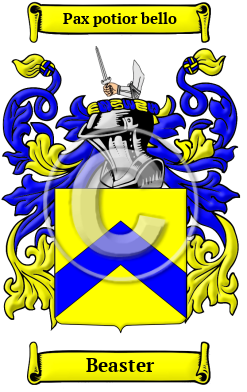
The motto was originally a war cry or slogan. Mottoes first began to be shown with arms in the 14th and 15th centuries, but were not in general use until the 17th century. Thus the oldest coats of arms generally do not include a motto. Mottoes seldom form part of the grant of arms: Under most heraldic authorities, a motto is an optional component of the coat of arms, and can be added to or changed at will; many families have chosen not to display a motto.
Motto: Pax potior bello
Motto Translation: Peace preferable to war.
- Shirley, Evelyn Philip, The Noble and Gentle Men of England; The Arms and Descents. Westminster: John Bower Nichols and Sons, 1866, Print.
- Burke, John Bernard, The Roll of Battle Abbey. London: Edward Churton, 26, Holles Street, 1848, Print.
- Worth, R.N., A History of Devonshire London: Elliot Stock, 62, Paternoster Row, E.G., 1895. Digital
- Lower, Mark Anthony, Patronymica Britannica, A Dictionary of Family Names of the United Kingdom. London: John Russel Smith, 1860. Print.
- Lewis, Samuel, A Topographical Dictionary of England. Institute of Historical Research, 1848, Print.

|