| ![Show Contents]() Beard History, Family Crest & Coats of Arms Beard History, Family Crest & Coats of Arms
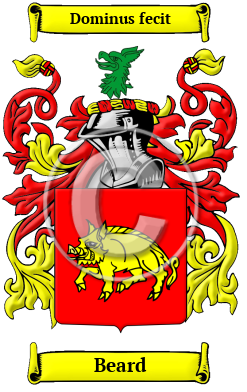
Etymology of BeardWhat does the name Beard mean? The chronicles of Scottish history reveal that the first people to use the name Beard were the Strathclyde-Britons. It was a name for a poet, which was originally derived from the Gaelic word bard. 1 Early Origins of the Beard familyThe surname Beard was first found in Lanarkshire (Gaelic: Siorrachd Lannraig) a former county in the central Strathclyde region of Scotland, now divided into the Council Areas of North Lanarkshire, South Lanarkshire, and the City of Glasgow, where they held a family seat from ancient times. According to legend, William the Lion, King of Scotland was alarmed by the approach of a wild boar, while hunting in one of the southwestern counties. Baird, who was a follower in the King's train, came forward to assist the King. Baird needed only a single arrow to slay the boar, and was rewarded for this service by the king. He was granted large areas of lands, and was assigned a Coat of Arms on which there is a wild boar. King William also commanded that Baird would have as his motto Dominus Fecit (The Lord made). In the Churchyard of Banff, Scotland, Baird's Arms may still be seen in an ancient monument to the Bairds of Auchmeddan. Early History of the Beard familyThis web page shows only a small excerpt of our Beard research. Another 143 words (10 lines of text) covering the years 1300, 1616, 1620, 1632, 1647, 1654, 1656, 1658, 1667, 1686, 1690, 1697, 1698, 1715, 1717, 1736, 1737, 1739, 1740, 1743, 1745, 1748, 1753, 1759 and 1890 are included under the topic Early Beard History in all our PDF Extended History products and printed products wherever possible. Beard Spelling VariationsPrior to the first dictionaries, scribes spelled words according to sound. This, and the fact that Scottish names were repeatedly translated from Gaelic to English and back, contributed to the enormous number of spelling variations in Scottish names. Beard has been spelled Baird, Bard, Barde, Baard, Bayard, Beard and many more. Early Notables of the Beard family- Thomas Beard (d. 1632), was a Puritan divine, and the schoolmaster of Oliver Cromwell at Huntingdon, was, it is believed, a native of Huntingdon, but the date of his birth is unknown. 2
Beard World RankingIn the United States, the name Beard is the 607th most popular surname with an estimated 47,253 people with that name. 3 However, in Australia, the name Beard is ranked the 642nd most popular surname with an estimated 6,068 people with that name. 4 And in the United Kingdom, the name Beard is the 633rd popular surname with an estimated 10,411 people with that name. 5 Migration of the Beard family to IrelandSome of the Beard family moved to Ireland, but this topic is not covered in this excerpt.
Another 60 words (4 lines of text) about their life in Ireland is included in all our PDF Extended History products and printed products wherever possible.
| Beard migration to the United States | + |
In such difficult times, the difficulties of raising the money to cross the Atlantic to North America did not seem so large compared to the problems of keeping a family together in Scotland. It was a journey well worth the cost, since it was rewarded with land and freedom the Scots could not find at home. The American War of Independence solidified that freedom, and many of those settlers went on to play important parts in the forging of a great nation. Among them:
Beard Settlers in United States in the 17th Century- Jon Beard, who landed in Virginia in 1637 6
- Joane Beard, who arrived in Virginia in 1638 6
- Robert Beard, who landed in Maryland in 1641 6
- William Beard, who arrived in New England in 1643 6
- Rachel Beard, who landed in Maryland in 1650 6
- ... (More are available in all our PDF Extended History products and printed products wherever possible.)
Beard Settlers in United States in the 18th Century- John Beard, who landed in Delaware in 1728 6
- Martin Beard, who arrived in Philadelphia, Pennsylvania in 1739 6
- Nicholas Beard, who landed in America in 1765 6
- Andrew Beard, who landed in Boston, Massachusetts in 1766 6
- Margaret Beard, who arrived in South Carolina in 1772 6
- ... (More are available in all our PDF Extended History products and printed products wherever possible.)
Beard Settlers in United States in the 19th Century- Ann Beard, aged 2, who landed in New York, NY in 1803 6
- Peter Beard, who arrived in America in 1806 6
- Hugh Beard, who landed in Maryland in 1810 6
- Jane Beard, who arrived in South Carolina in 1813 6
- Mr. Beard, who landed in Mobile, Ala in 1821 6
- ... (More are available in all our PDF Extended History products and printed products wherever possible.)
Beard Settlers in United States in the 20th Century- Mr. Arthur Beard, (b. 1866), aged 37, Cornish mason, from Redruth, Cornwall, UK travelling aboard the ship "Oceanic" arriving at Ellis Island, New York on 5th February 1903 en route to Bridgeport, Connecticut, USA 7
- Mr. Henry Beard, (b. 1881), aged 23, Cornish cabinet maker, from Redruth, Cornwall, UK travelling aboard the ship "Cedric" arriving at Ellis Island, New York on 20th February 1904 en route to Bridgeport, Connecticut, USA 7
- Mr. William Charles Beard, (b. 1886), aged 19, Cornish farm labourer, from Cuby, Cornwall, UK travelling aboard the ship "Saint Paul" arriving at Ellis Island, New York on 1st May 1905 en route to Calumet, Michigan, USA 7
| Beard migration to Canada | + |
Beard Settlers in Canada in the 17th Century- Joseph Béard, who married in Longue-Pointe, Quebec in 1699
Beard Settlers in Canada in the 19th Century- Ellen Beard, aged 25, who arrived in Saint John, New Brunswick aboard the ship "Ambassador" in 1834
- David Béard was a store-keeper in Indian Cove, Newfoundland in 1871 8
- George J Béard was owner of a coal yard in Montreal in 1871
- John Béard lived in Montreal in 1871
- Samuel W. Béard was owner of a coal yard in Montreal in 1871
- ... (More are available in all our PDF Extended History products and printed products wherever possible.)
| Beard migration to Australia | + |
Emigration to Australia included the Third Fleet of convicts, tradespeople and early settlers. Early immigrants include: Following the Third Fleets, other convicts and early settlers arriving in Australia include: Beard Settlers in Australia in the 19th Century- Mr. Timothy Beard, (Baird, Board, Bard), (1764 - 1848), aged 41, British carpenter who was convicted in Gloucestershire, England for life for stealing sheep, transported aboard the "Fortune And Alexander" on 31st December 1805, arriving in New South Wales, Australia 9
- Mr. Henry Beard, (b. 1788), aged 28, English convict who was convicted in Middlesex, England for life, transported aboard the "Fame" on 9th October 1816, arriving in New South Wales, Australia, he died in 1849 10
- Mr. Henry Beard, English convict who was convicted in Gloucestershire, England for life, transported aboard the "Florentia" on 14th August 1827, arriving in New South Wales, Australia, he died in 1867 11
- Henry Beard, English convict from Gloucester, who was transported aboard the "America" on April 4, 1829, settling in New South Wales, Australia 12
- Mr. Richard Beard, (b. 1803), aged 28, English convict who was convicted in Stafford, Staffordshire, England for 14 years, transported aboard the "Exmouth" on 3rd March 1831, arriving in New South Wales, Australia, he died in 1831 aboard the ship 13
- ... (More are available in all our PDF Extended History products and printed products wherever possible.)
| Beard migration to New Zealand | + |
Emigration to New Zealand followed in the footsteps of the European explorers, such as Captain Cook (1769-70): first came sealers, whalers, missionaries, and traders. By 1838, the British New Zealand Company had begun buying land from the Maori tribes, and selling it to settlers, and, after the Treaty of Waitangi in 1840, many British families set out on the arduous six month journey from Britain to Aotearoa to start a new life. Early immigrants include: Beard Settlers in New Zealand in the 19th Century- John Beard, who landed in Wellington, New Zealand in 1840
- James Beard, aged 22, a carpenter, who arrived in Wellington, New Zealand aboard the ship "Alma" in 1857
- Ann Beard, aged 21, who arrived in Wellington, New Zealand aboard the ship "Alma" in 1857
- Edward Beard, aged 2, who arrived in Wellington, New Zealand aboard the ship "Alma" in 1857
- Mr. Beard, British settler travelling from Liverpool aboard the ship "Tornado" arriving in Auckland, New Zealand on 26th September 1859 14
- ... (More are available in all our PDF Extended History products and printed products wherever possible.)
| Beard migration to West Indies | + |
The British first settled the British West Indies around 1604. They made many attempts but failed in some to establish settlements on the Islands including Saint Lucia and Grenada. By 1627 they had managed to establish settlements on St. Kitts (St. Christopher) and Barbados, but by 1641 the Spanish had moved in and destroyed some of these including those at Providence Island. The British continued to expand the settlements including setting the First Federation in the British West Indies by 1674; some of the islands include Barbados, Bermuda, Cayman Island, Turks and Caicos, Jamaica and Belize then known as British Honduras. By the 1960's many of the islands became independent after the West Indies Federation which existed from 1958 to 1962 failed due to internal political conflicts. After this a number of Eastern Caribbean islands formed a free association. 15Beard Settlers in West Indies in the 17th Century- Godfery Beard, aged 22, who landed in Barbados in 1682 6
- Godfrey Beard, aged 22, who landed in Barbados in 1682 6
| Contemporary Notables of the name Beard (post 1700) | + |
- Mamie Lee Beard (b. 1915), American private in the 6888th Central Postal Directory Battalion, first all-female, all-African-American battalion to server overseas
- James Arthur "Jim" Beard (1960-2024), American jazz pianist and keyboardist, composer, arranger and producer who worked with Steely Dan, Wayne Shorter, John McLaughlin, Pat Metheny, John Scofield and others
- James Andrew Beard (1903-1985), American chef, cookbook author, teacher and television personality.
- Edward Leroy "Ed" Beard (1939-2023), American professional football player for the San Francisco 49ers (1965-1972)
- Santonio Beard (1980-2022), American football player, running back for the University of Alabama, he shares a University of Alabama record for the most touchdowns in a single game with five
- Andrew Jackson Beard (1849-1921), American inventor inducted into the National Inventors Hall of Fame for his work on railroad coupler design
- Mark William Beard (1948-2021), American stock car racing team owner and driver who owned the NASCAR Cup Series team Beard Motorsports
- Edward Peter Beard (1940-2021), American businessman and politician, Member of the U.S. House of Representatives from Rhode Island (1975-1981)
- Peter Hill Beard (1938-2020), American artist, photographer, diarist, and writer
- ... (Another 65 notables are available in all our PDF Extended History products and printed products wherever possible.)
| Historic Events for the Beard family | + |
- Mr. Ernest Edmond Beard (1887-1917), Canadian Stoker Petty Officer aboard the HMCS Niobe from Belleville, Ontario, Canada who died in the Halifax Explosion (1917) 16
- Mr. Thomas Norman Kemp Beard (b. 1903), Canadian Midshipman serving for the Royal Canadian Navy from Victoria, British Columbia, Canada, who sailed into battle and died in the HMS Hood sinking 17
- Mr. Robert Alan Beard (b. 1919), English Marine serving for the Royal Marine from Tamworth, Staffordshire, England, who sailed into battle and died in the HMS Hood sinking 18
- Mr. James Beard (b. 1826), Welsh coal miner who was working at the Prince of Wales colliery in Abercarn, Wales on the 11th September 1878 when there was a coal mine explosion; he died 18
The motto was originally a war cry or slogan. Mottoes first began to be shown with arms in the 14th and 15th centuries, but were not in general use until the 17th century. Thus the oldest coats of arms generally do not include a motto. Mottoes seldom form part of the grant of arms: Under most heraldic authorities, a motto is an optional component of the coat of arms, and can be added to or changed at will; many families have chosen not to display a motto.
Motto: Dominus fecit
Motto Translation: The Lord made.
| Suggested Readings for the name Beard | + |
- A Beard Mosaic: David Beard and His Descendants by Virginia Beard Asterino.
- History of the Beard, Bedichek, Craven and Allied Families by Pauline Beard.
- Lower, Mark Anthony, Patronymica Britannica, A Dictionary of Family Names of the United Kingdom. London: John Russel Smith, 1860. Print.
- Smith, George (ed), Dictionary of National Biography. London: Smith, Elder & Co., 1885-1900. Print
- "What are the 5,000 Most Common Last Names in the U.S.?". NameCensus.com, https://namecensus.com/last-names/
- "Most Common Last Names in Australia." Forebears, https://forebears.io/australia/surnames
- "UK surname ranking." UK Surname map, https://www.surnamemap.eu/unitedkingdom/surnames_ranking.php?p=10
- Filby, P. William, Meyer, Mary K., Passenger and immigration lists index : a guide to published arrival records of about 500,000 passengers who came to the United States and Canada in the seventeenth, eighteenth, and nineteenth centuries. 1982-1985 Cumulated Supplements in Four Volumes Detroit, Mich. : Gale Research Co., 1985, Print (ISBN 0-8103-1795-8)
- Cornwall Online Parish Clerks. (Retreived 3rd May 2018). Retrieved from http://www.opc-cornwall.org/Resc/pdfs/emigration_ellis_island_1892_on.pdf
- Seary E.R., Family Names of the Island of Newfoundland, Montreal: McGill's-Queen's Universtity Press 1998 ISBN 0-7735-1782-0
- Convict Records Voyages to Australia (Retrieved 24th October 2022). https://convictrecords.com.au
- Convict Records Voyages to Australia (Retrieved 27th September 2022). https://convictrecords.com.au/ships/fairlie
- Convict Records Voyages to Australia (Retrieved 5th October 2022). https://convictrecords.com.au/ships/florentia
- State Library of Queensland. (Retrieved 2014, November 26) America voyage to New South Wales, Australia in 1829 with 176 passengers. Retrieved from http://www.convictrecords.com.au/ships/america/1829
- Convict Records Voyages to Australia (Retrieved 25th May 2022). https://convictrecords.com.au/ships/exmouth
- New Zealand Yesteryears Passenger Lists 1800 to 1900 (Retrieved 26th March 2019). Retrieved from http://www.yesteryears.co.nz/shipping/passlist.html
- https://en.wikipedia.org/wiki/British_West_Indies
- Halifax Explosion Book of Remembrance | Maritime Museum of the Atlantic. (Retrieved 2014, June 23) . Retrieved from https://maritimemuseum.novascotia.ca/what-see-do/halifax-explosion/halifax-explosion-book-remembrance
- H.M.S. Hood Association-Battle Cruiser Hood: Crew Information - H.M.S. Hood Rolls of Honour, Men Lost in the Sinking of H.M.S. Hood, 24th May 1941. (Retrieved 2016, July 15) . Retrieved from http://www.hmshood.com/crew/memorial/roh_24may41.htm
- Entombed in flood and flame (retrieved 3rd August 2021). Retrieved from https://web.archive.org/web/20120603025705/http://www.crosskeys.me.uk/history/prince.htm
 |