| ![Show Contents]() Ball History, Family Crest & Coats of Arms Ball History, Family Crest & Coats of Arms
Etymology of BallWhat does the name Ball mean? The ancient Anglo-Saxon culture of England produced the name of Ball. It was given to a person who was bald deriving its origin from the Old English word Bealla, which meant bald. The surname may also refer to someone who had a rotund or stocky stature. 1 While many researchers share this same "nickname" origin of the name, Henry Brougham Guppy in 1890, wrote "The idea that these names originated from bald - headed ancestors is, I think, absurd. Camden, in his remarks on surnames, written some 300 years ago, informs us that Baul and Bald were then nicknames or nursenames for Baldwin, and it was evidently from this source that Mr. Lower borrowed the suggestion that Ball was a nickname of Baldwin." 2 Early Origins of the Ball familyThe surname Ball was first found in the "west side of England, being at present most numerous in Lancashire, Staffordshire, Warwickshire, and Gloucestershire. This surname must be distinguished in its distribution from Balls, which is restricted to the opposite or east side of England, in the counties of Norfolk, Suffolk, and Essex. It is remarkable that after the lapse of six centuries Balls remains doggedly in the same part of England, whilst Ball and Baldwin seem to have extended their areas westward. In Norfolk three centuries ago Balls was sometimes spelt Balles or Ballis. " 2 The earliest record of the family was found in the Hundredorum Rolls of 1273 which reflected the scattered occurrences of the family and early spellings recorded: Custance Balde, Cambridgeshire; Richard Bald, Oxfordshire; John Balle, Norfolk; and Albred Balle, Huntingdonshire. 1 Kirby's Quest had several entries: John Balde, Somerset, 1 Edward III (recorded during the first year's reign of Edward III.) John atte Balle, Somerset, 1 Edward III; and Henry atte Balle, Somerset, 1 Edward III. 3 John Ball (d. 1381), was an early English priest, who provoked the insurrection of Wat Tyler. As a result of his actions, he was "brought before the king at St. Albans, where he was sentenced to be hanged, drawn, and quartered as a traitor. The sentence seems to have been promptly carried out, and the king himself witnessed its execution at St. Albans on 15 July. " 4 Early History of the Ball familyThis web page shows only a small excerpt of our Ball research. Another 161 words (12 lines of text) covering the years 1381, 1530, 1553, 1585, 1590, 1623, 1626, 1631, 1637, 1639, 1640, 1659, 1664, 1665, 1675, 1680, 1681, 1690, 1731, 1745, 1887, 1890 and 1992 are included under the topic Early Ball History in all our PDF Extended History products and printed products wherever possible. Ball Spelling VariationsOne relatively recent invention that did much to standardize English spelling was the printing press. However, before its invention even the most literate people recorded their names according to sound rather than spelling. The spelling variations under which the name Ball has appeared include Ball, Balle, Balls, Balders and others. Early Notables of the Ball family- John Ball (1585-1640), English Puritan divine, born at Cassington, Oxfordshire, in October 1585
- Thomas Ball (1590-1659), was an English divine, born at Aberbury in Shropshire. "His parents were of 'good and honest repute,' having neither 'superfluity nor want.' " 4
- William Ball or Balle (c. 1631-1690), was an early an English astronomer, one of the founding Fellows of the Royal Society. He was the eldest of seventeen children born to Sir Peter Ball, knight, reco...
- Nathaniel Ball (1623-1681), was an English divine, assistant to Walton in his great 'Polyglot,' and was born at Pitminster, near Taunton Dean, Somersetshire. 4
- Sir Peter Ball (died 1680), was an English lawyer and politician who sat in the House of Commons between 1626 and 1640, and was Attorney General to Queen Henrietta Maria
- Peter Ball or Balle, M.D. (died 1675), was an English physician, honorary fellow of the Royal College of Physicians in December 1664
- Robert Balle (c.1639-1731), of Mamhead, Devon; Campden House, Kensington, London; and Leghorn, Italy, was an English Member of Parliament (MP) and son of Sir Peter Balle, MP for Tiverton
Ball World RankingIn the United States, the name Ball is the 320th most popular surname with an estimated 84,558 people with that name. 5 However, in Canada, the name Ball is ranked the 484th most popular surname with an estimated 10,023 people with that name. 6 And in Newfoundland, Canada, the name Ball is the 302nd popular surname with an estimated 150 people with that name. 7 France ranks Ball as 6,104th with 1,000 - 1,500 people. 8 Australia ranks Ball as 297th with 11,906 people. 9 New Zealand ranks Ball as 299th with 2,031 people. 10 The United Kingdom ranks Ball as 134th with 37,504 people. 11 Migration of the Ball family to IrelandSome of the Ball family moved to Ireland, but this topic is not covered in this excerpt.
Another 181 words (13 lines of text) about their life in Ireland is included in all our PDF Extended History products and printed products wherever possible.
| Ball migration to the United States | + |
At this time, the shores of the New World beckoned many English families that felt that the social climate in England was oppressive and lacked opportunity for change. Thousands left England at great expense in ships that were overcrowded and full of disease. A great portion of these settlers never survived the journey and even a greater number arrived sick, starving, and without a penny. The survivors, however, were often greeted with greater opportunity than they could have experienced back home. These English settlers made significant contributions to those colonies that would eventually become the United States and Canada. An examination of early immigration records and passenger ship lists revealed that people bearing the name Ball arrived in North America very early:
Ball Settlers in United States in the 17th Century- Richard Ball, who landed in Virginia in 1617 13
- James Ball, who arrived in Boston, Massachusetts in 1622 13
- Mrs. Robert Ball, who arrived in Virginia in 1622 13
- Robert Ball, who landed in Virginia in 1623 13
- Goodwife Ball, who settled in Virginia in 1623
- ... (More are available in all our PDF Extended History products and printed products wherever possible.)
Ball Settlers in United States in the 18th Century- Eliz Ball, who landed in Virginia in 1705 13
- Samuel Ball, who arrived in Virginia in 1705 13
- Will Ball, who landed in Virginia in 1705 13
- Catharina Ball, who landed in New York in 1709 13
- Richard Ball, who landed in Virginia in 1714 13
- ... (More are available in all our PDF Extended History products and printed products wherever possible.)
Ball Settlers in United States in the 19th Century- Matthew Ball, who landed in Maryland in 1803 13
- Prudence Ball, aged 30, who arrived in Baltimore, Maryland in 1804 13
- James Ball, who arrived in Charleston, South Carolina in 1807 13
- Luke Ball, who arrived in America in 1810 13
- Abraham Ball, aged 45, who arrived in New York in 1812 13
- ... (More are available in all our PDF Extended History products and printed products wherever possible.)
Ball Settlers in United States in the 20th Century- Mr. Albert Ball, (b. 1878), aged 22, Cornish labourer, from St Austell, Cornwall travelling aboard the ship "Majestic" arriving at Ellis Island, New York on 20th September 1900 en route to Calumet, Michigan, UCA 14
- Mr. William Ball, (b. 1863), aged 38, Cornish miner, from Liskeard, Cornwall travelling aboard the ship "Oceanic" arriving at Ellis Island, New York on 11th September 1901 en route to Whitesboro, New York USA 14
- Mr. James Ball, (b. 1880), aged 24, Cornish miner travelling aboard the ship "St Louis" arriving at Ellis Island, New York on 18th July 1904 en route to Los Angeles, California, USA 14
- Miss Lilian Ball, (b. 1894), aged 11, Cornish setter, from St Austell, Cornwall travelling aboard the ship "Lucania" arriving at Ellis Island, New York in 1905 en route to Indianapolis, Indiana, USA 14
| Ball migration to Canada | + |
Ball Settlers in Canada in the 18th Century- William Ball, a fisherman of St. John's or Petty Harbour, Newfoundland in 1740 15
- Richard Ball, a J.P. of the Ferryland District, Newfoundland in 1750 15
- Mary Ball, who landed in Halifax, Nova Scotia in 1778
- Private Jacob Ball U.E. (b. 1764) born in New Fane, Vermont, USA from Vermont, USA who settled in Sutton, Brome-Missisquoi Regional County, Quebec c. 1783 part of the Queen's Loyal Rangers, 4th Company with Captain Justus Sherwood's Company, he married Elizabeth H. Stone in 1785 the had 5 children, he died in 1831 in Knowlton, Quebec 16
- Mrs. Elizabeth Ball U.E., (née Stone) (b. 1771) who settled in Sutton, Brome-Missisquoi Regional County, Quebec c. 1783 she married Private Jacob Ball in 1785, died in 1865 16
- ... (More are available in all our PDF Extended History products and printed products wherever possible.)
Ball Settlers in Canada in the 19th Century- George Ball, a planter of Cuckold's Cove, Newfoundland in 1824 15
- Edward Ball, aged 30, a labourer, who arrived in Saint John, New Brunswick in 1834 aboard the ship "Edwin" from Dublin, Ireland
- Henry Ball from County Waterford, Ireland, was married in St. John's, Newfoundland in 1838 15
- Stephen H Ball, who arrived in Canada in 1841
- Abraham Ball, a fisherman of Reccontre in 1850; there is a Ball Island and Captain Ball Rock in Newfoundland 15
Ball Settlers in Canada in the 20th Century- Mrs. Lillie Ball, (b. 1873), aged 30, Cornish housewife, from St Austell, Cornwall travelling aboard the ship "Cedric" arriving at Ellis Island, New York on 20th February 1903 en route to Toronto, Canada 14
- Mr. James Ball, (b. 1872), aged 31, Cornish stationer, from St Austell, Cornwall travelling aboard the ship "Cedric" arriving at Ellis Island, New York on 20th February 1903 en route to Toronto, Canada 14
| Ball migration to Australia | + |
Emigration to Australia included the Second Fleet and Third Fleet of convicts, tradespeople and early settlers. Early immigrants include: Second Fleet - Mr. Francis Ball, (d. 1795), British settler convicted in Middlesex, England in 1789, sentenced to 7 years for stealing, transported aboard the ship "Albermarle" leaving in 1790 arriving in New South Wales, Australia in 1791 12
Third Fleet - Mr. John Ball, (b. 1734), aged 53, English settler convicted in Exeter, Devon on 20th March 1786, sentenced for 7 years for stealing animals, transported aboard the ship "Charlotte" leaving on 13th May 1787 arriving in New South Wales, Australia on 22nd January 1788, died in Sydney 13
- Mr. Henry Lidgbird Ball, (1756 - 1818), British Rear-Admiral on the Navy support ship for the First Fleet the "HMAT Supply" leaving in 1787 arriving in New South Wales, Australia in 1788
Following the Second and Third Fleets, other convicts and early settlers arriving in Australia include: Ball Settlers in Australia in the 18th CenturyBall Settlers in Australia in the 19th Century- Mr. Thomas Ball, English convict who was convicted in Lancaster, Lancashire, England for 14 years, transported aboard the "Elizabeth" in May 1816, arriving in New South Wales, Australia 18
- Mr. John Ball, English convict who was convicted in Kent, England for life, transported aboard the "Dromedary" on 11th September 1819, arriving in Tasmania (Van Diemen's Land) 19
- Mr. John Ball, British Convict who was convicted in Berkshire, England for life, transported aboard the "Earl St Vincent" on 6th April 1820, arriving in New South Wales, Australia 20
- Mr. Thomas Ball, British Convict who was convicted in Berkshire, England for life, transported aboard the "Earl St Vincent" on 6th April 1820, arriving in New South Wales, Australia 20
- Mr. Arthur Ball who was convicted in Stafford, Staffordshire, England for 7 years, transported aboard the "Dick" on 2nd October 1820, arriving in New South Wales, Australia 21
- ... (More are available in all our PDF Extended History products and printed products wherever possible.)
| Ball migration to New Zealand | + |
Emigration to New Zealand followed in the footsteps of the European explorers, such as Captain Cook (1769-70): first came sealers, whalers, missionaries, and traders. By 1838, the British New Zealand Company had begun buying land from the Maori tribes, and selling it to settlers, and, after the Treaty of Waitangi in 1840, many British families set out on the arduous six month journey from Britain to Aotearoa to start a new life. Early immigrants include: Ball Settlers in New Zealand in the 19th Century- Mr. Thomas Ball, Australian settler travelling from Port of Hobart, Tasmania, Australia on board the ship "David Owen" arriving in New Zealand in 1832 22
- Alfred Ball, who landed in Wellington, New Zealand in 1840
- Richard Ball, who landed in Wellington & Wanganui, New Zealand in 1841
- Thomas T Ball, who landed in Wanganui, New Zealand in 1843
- Phillip Ball, aged 40, who arrived in Wellington, New Zealand aboard the ship "Seringapatam" in 1856
- ... (More are available in all our PDF Extended History products and printed products wherever possible.)
| Ball migration to West Indies | + |
The British first settled the British West Indies around 1604. They made many attempts but failed in some to establish settlements on the Islands including Saint Lucia and Grenada. By 1627 they had managed to establish settlements on St. Kitts (St. Christopher) and Barbados, but by 1641 the Spanish had moved in and destroyed some of these including those at Providence Island. The British continued to expand the settlements including setting the First Federation in the British West Indies by 1674; some of the islands include Barbados, Bermuda, Cayman Island, Turks and Caicos, Jamaica and Belize then known as British Honduras. By the 1960's many of the islands became independent after the West Indies Federation which existed from 1958 to 1962 failed due to internal political conflicts. After this a number of Eastern Caribbean islands formed a free association. 23Ball Settlers in West Indies in the 17th Century- Mr. George Ball, (b. 1584), aged 51, British settler traveling aboard the ship "Matthew" arriving in St Christopher (Saint Kitts) in 1635 24
- Elizabeth Ball, who settled in Barbados in 1674
- Humphrey Ball, his wife Elizabeth, and daughter Mary settled in Barbados in 1678
| Contemporary Notables of the name Ball (post 1700) | + |
- Lucille Désirée Ball (1911-1989), American actress, comedienne, television star and recipient of the Presidential Medal of Freedom
- Sam Ball (1944-2023), American professional football player who was an offensive lineman for the Baltimore Colts
- Coolidge Ball (1951-2023), American businessman and basketball player, the first African American athlete to play in any sport at the University of Mississippi (Ole Miss) in Oxford, Mississippi
- Kirshnik Khari Ball (1994-2022), known professionally as Takeoff, an American rapper, best known as a member of the hip hop trio Migos
- Neiron Ball (1992-2019), American NFL outside linebacker football player who played for the Oakland Raiders (2015–2016)
- David Standish Ball (1926-2017), American Episcopal prelate, Bishop of Albany (1984–1998)
- Samuel Henry "Errie" Ball (1910-2014), Welsh-American professional golfer, the last living person to compete in the first Masters dying at the age of 103, inducted into the PGA Hall of Fame in 2011
- Anne Firestone Ball (1934-2013), American philanthropist, heir to Firestone Tire and Rubber Company
- Ernest Ball (1878-1927), American composer
- ... (Another 144 notables are available in all our PDF Extended History products and printed products wherever possible.)
| Historic Events for the Ball family | + |
- Kester Roger Marcus Ball (1972-1989), English schoolboy who was attending the FA Cup semi-final at Hillsborough Stadium, in Sheffield, Yorkshire when the stand allocated area became overcrowded and 96 people were crushed in what became known as the Hillsborough disaster and he died from his injuries, his school named his sixth form block "Kester Ball House" in his memory 25
- Mr. William Ball (b. 1923), English Leading Stoker serving for the Royal Navy from Liverpool, England, who sailed into battle and died in the HMS Hood sinking 26
- Mr. Philip A Ball (b. 1922), English Stoker 1st Class serving for the Royal Navy from Salisbury, Wiltshire, England, who sailed into battle and died in the HMS Hood sinking 27
- Mr. Charles F D Ball (b. 1920), English Able Seaman serving for the Royal Navy from Kemp Town, Brighton, England, who sailed into battle and died in the HMS Hood sinking 27
- Mr. John Ball, British Marine, who sailed into battle on the HMS Prince of Wales (1941) and survived the sinking 27
- ... (Another 11 entries are available in all our PDF Extended History products and printed products wherever possible.)
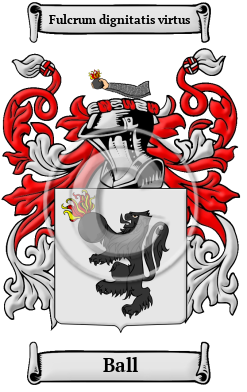
The motto was originally a war cry or slogan. Mottoes first began to be shown with arms in the 14th and 15th centuries, but were not in general use until the 17th century. Thus the oldest coats of arms generally do not include a motto. Mottoes seldom form part of the grant of arms: Under most heraldic authorities, a motto is an optional component of the coat of arms, and can be added to or changed at will; many families have chosen not to display a motto.
Motto: Fulcrum dignitatis virtus
Motto Translation: Virtue is the support of dignity
| Suggested Readings for the name Ball | + |
- Ball Cousins: Descendants of John and Sarah Ball and of William and Elizabeth Richards of Colonial Philadelphia County, Pennsylvania by Margaret B. Kinsey.
- Ball Family Chart by Charles M. Noble.
- Bardsley, C.W, A Dictionary of English and Welsh Surnames: With Special American Instances. Wiltshire: Heraldry Today, 1901. Print. (ISBN 0-900455-44-6)
- Guppy, Henry Brougham, Homes of Family Names in Great Britain. 1890. Print.
- Dickinson, F.H., Kirby's Quest for Somerset of 16th of Edward the 3rd London: Harrison and Sons, Printers in Ordinary to Her Majesty, St, Martin's Lane, 1889. Print.
- Smith, George (ed), Dictionary of National Biography. London: Smith, Elder & Co., 1885-1900. Print
- "What are the 5,000 Most Common Last Names in the U.S.?". NameCensus.com, https://namecensus.com/last-names/
- "Surnames Meanings, Origins & Distribution Maps - Forebears." Forebears, https://forebears.io/surnames
- The order of Common Surnames in 1955 in Newfoundland retrieved on 20th October 2021 (retrieved from Family Names of the Island of Newfoundland by E.R. Seary corrected edition ISBN 0-7735-1782-0)
- http://www.journaldesfemmes.com/nom-de-famille/nom/
- "Most Common Last Names in Australia." Forebears, https://forebears.io/australia/surnames
- "Most Common Last Names in New Zealand." Forebears, https://forebears.io/new-zealand/surnames
- "UK surname ranking." UK Surname map, https://www.surnamemap.eu/unitedkingdom/surnames_ranking.php?p=10
- Convict Records of Australia. Retrieved 4th February 2021 from https://convictrecords.com.au/ships
- Filby, P. William, Meyer, Mary K., Passenger and immigration lists index : a guide to published arrival records of about 500,000 passengers who came to the United States and Canada in the seventeenth, eighteenth, and nineteenth centuries. 1982-1985 Cumulated Supplements in Four Volumes Detroit, Mich. : Gale Research Co., 1985, Print (ISBN 0-8103-1795-8)
- Cornwall Online Parish Clerks. (Retreived 3rd May 2018). Retrieved from http://www.opc-cornwall.org/Resc/pdfs/emigration_ellis_island_1892_on.pdf
- Seary E.R., Family Names of the Island of Newfoundland, Montreal: McGill's-Queen's Universtity Press 1998 ISBN 0-7735-1782-0
- Rubincam, Milton. The Old United Empire Loyalists List. Genealogical Publishing Co., Inc, 1976. (Originally published as; United Empire Loyalists. The Centennial of the Settlement of Upper Canada. Rose Publishing Company, 1885.) ISBN 0-8063-0331-X
- Convict Records Voyages to Australia (Retrieved 29th September 2020). Retrieved from https://convictrecords.com.au/ships/barwell
- Convict Records Voyages to Australia (Retrieved 1st March 2022). Retrieved from https://convictrecords.com.au/ships/elizabeth
- Convict Records Voyages to Australia (Retrieved 16th July 2021). Retrieved from https://convictrecords.com.au/ships/dromedary
- Convict Records Voyages to Australia (Retrieved 10th September 2021). Retrieved from https://convictrecords.com.au/ships/earl-st-vincent
- Convict Records Voyages to Australia (Retrieved 8th July 2021). Retrieved from https://convictrecords.com.au/ships/Dick
- New Zealand Yesteryears Passenger Lists 1800 to 1900 (Retrieved 17th October 2018). Retrieved from http://www.yesteryears.co.nz/shipping/passlist.html
- https://en.wikipedia.org/wiki/British_West_Indies
- Pilgrim Ship's of 1600's (Retrieved October 4th 2021 from https://www.packrat-pro.com/ships/shiplist.htm
- Hillsborough Victims (retreived 21st March 2021). Retreived from https://metro.co.uk/2019/04/15/remembering-96-victims-hillsborough-disaster-30-years-9206566/
- H.M.S. Hood Association-Battle Cruiser Hood: Crew Information - H.M.S. Hood Rolls of Honour, Men Lost in the Sinking of H.M.S. Hood, 24th May 1941. (Retrieved 2016, July 15) . Retrieved from http://www.hmshood.com/crew/memorial/roh_24may41.htm
- HMS Prince of Wales Crew members. (Retrieved 2014, April 9) . Retrieved from http://www.forcez-survivors.org.uk/biographies/listprincecrew.html
 |