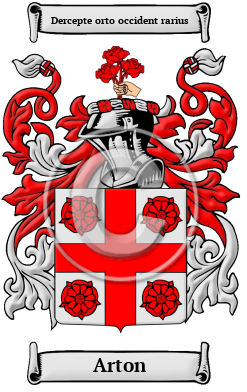
| ![Show Contents]() Arton History, Family Crest & Coats of Arms Arton History, Family Crest & Coats of Arms
Early Origins of the Arton familyThe surname Arton was first found in the county of Berwickshire, where Ayton is a small town "which takes its name from the water of Eye, on the banks of which it is situated, is intimately connected with important transactions of early times. It was formerly dependent on the monastery of Coldingham, as appears from charters belonging to that establishment, upon the settlement of which, between the years 1098 and 1107, under the auspices of King Edgar, that monarch made them several grants, including "Eytun" and "aliam Eytun," the latter being Nether Ayton, on the opposite side of the river." 1 One of the first records of the name was William de Eytone who rendered homage to King Edward I in 1296. 2 The Yorkshire Poll Tax Rolls of 1379 had two entries for the family: Nicholas de Ayrton, at Alwoodly in the West Riding of Yorkshire and Willelmu de Ayreton at Rimington, in the West Riding. William Ayretron was a Freeman of York in 1460 and Robart Airton was listed at Rystone in the West Riding of Yorkshire in 1560. 3 "The Aitones of Kippo, Fifeshire, Scotland a branch of Aiton of that Ilk, adopted for the motto 'Et decerptae dabunt odorem,' an elegant allusion to their crest." 4 Early History of the Arton familyThis web page shows only a small excerpt of our Arton research. Another 253 words (18 lines of text) covering the years 1170, 1296, 1440, 1460, 1488, 1513, 1570, 1638, 1644, 1672, 1734, 1764, 1777, 1801, 1813, 1826, 1837, 1851 and 1887 are included under the topic Early Arton History in all our PDF Extended History products and printed products wherever possible. Arton Spelling VariationsThe name Arton, appeared in many references, and from time to time, the surname was spelt Aiton, Ayton, Aytoun and others. Early Notables of the Arton familySir Robert Ayton or Aytoun (1570-1638), English poet, who was also a private secretary to the queens of James I and Charles I. He "was a descendant of the Norman house of De Vescy, lords of Sprouston in Northumberland. Gilbert de Vescy, a younger son of the family, settled in Scotland in the reign of King Robert Bruce, having received from him the lands of Aytoun in Berwickshire. Thereupon he changed his name to that of his estate. " 5 "In Berwickshire the Aytouns continued as landowners until James III (1460-1488), when a brother of the family of Home married the heiress...
Another 108 words (8 lines of text) are included under the topic Early Arton Notables in all our PDF Extended History products and printed products wherever possible. Migration of the Arton familyThe New World beckoned as many of the settlers in Ireland, known as the Scotch/Irish, became disenchanted. They sailed aboard the armada of sailing ships known as the "White Sails" which plied the stormy Atlantic. Some called them, less romantically, the "coffin ships." Amongst the early settlers who could be considered kinsmen of the Arton family, or who bore a variation of the surname Arton were James Ayton settled in Virginia in 1716.
The motto was originally a war cry or slogan. Mottoes first began to be shown with arms in the 14th and 15th centuries, but were not in general use until the 17th century. Thus the oldest coats of arms generally do not include a motto. Mottoes seldom form part of the grant of arms: Under most heraldic authorities, a motto is an optional component of the coat of arms, and can be added to or changed at will; many families have chosen not to display a motto.
Motto: Et decerptae dabunt odorem
- Lewis, Samuel, A Topographical Dictionary of England. Institute of Historical Research, 1848, Print.
- Black, George F., The Surnames of Scotland Their Origin, Meaning and History. New York: New York Public Library, 1946. Print. (ISBN 0-87104-172-3)
- Hanks, Patricia and Flavia Hodges, A Dictionary of Surnames. Oxford: Oxford University Press, 1988. Print. (ISBN 0-19-211592-8)
- Burke, John Bernard, The Roll of Battle Abbey. London: Edward Churton, 26, Holles Street, 1848, Print.
- Smith, George (ed), Dictionary of National Biography. London: Smith, Elder & Co., 1885-1900. Print
 |