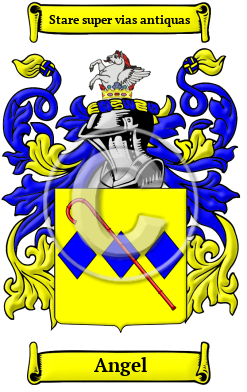
| ![Show Contents]() Angel History, Family Crest & Coats of Arms Angel History, Family Crest & Coats of Arms
Etymology of AngelWhat does the name Angel mean? The rich and ancient history of the Angel family name dates back to the time of the Anglo-Saxon tribes of Britain. It comes from the Old English personal name Angel, which is derived from the Latin Angelus and the Greek Angelos, which means a messenger. The personal name also appeared in the feminine forms of Angela and Angelina. 1 The name is denoted for "one who acted as a religious messenger or as a messenger from God; a nickname for an angelic person; descendant of Angel, a man's name in England." 2 Early Origins of the Angel familyThe surname Angel was first found in Lancashire where they held a family seat from very early times, some say before the Norman Conquest of England by Duke William in 1066 A.D. It is likely that this name originated in one of the conquering families of Angles who settled in Lancashire after the conquest of the Strathclyde Britons. The name was written in early records as Anglicus, but the name was carried from England to France as D'Anglars. Early History of the Angel familyThis web page shows only a small excerpt of our Angel research. Another 55 words (4 lines of text) covering the years 1555, 1610, 1618, 1636, 1655 and 1694 are included under the topic Early Angel History in all our PDF Extended History products and printed products wherever possible. Angel Spelling VariationsSpelling variations in names were a common occurrence before English spelling was standardized a few hundred years ago. In the Middle Ages, even the literate spelled their names differently as the English language incorporated elements of French, Latin, and other European languages. Many variations of the name Angel have been found, including Angell, Angel, Angle, Anegall, Anegal, Anegoll and others. Early Notables of the Angel family- John Angel (fl. 1555), Chaplain to King Philip and Queen Mary, is said to have been a 'person of singular zeal and learning.'
- John Angel or Angell (d. 1655), was 'a Gloucestershire man,' born towards the end of the sixteenth century. "He was admitted to Magdalen Hall, Oxford in 1610 and was ordained in holy orders; at a boun...
- Thomas Angell (c.1618-1694), was an English settler, one of the four men who wintered with Roger Williams at Seekonk, Plymouth Colony, in early 1636, and then joined him in founding the settlement of...
Angel Rankingthe United States, the name Angel is the 2,370th most popular surname with an estimated 12,435 people with that name. 3 However, in France, the name Angel is ranked the 3,588th most popular surname with an estimated 1,500 - 2,000 people with that name. 4
| Angel migration to the United States | + |
Families began migrating abroad in enormous numbers because of the political and religious discontent in England. Often faced with persecution and starvation in England, the possibilities of the New World attracted many English people. Although the ocean trips took many lives, those who did get to North America were instrumental in building the necessary groundwork for what would become for new powerful nations. Among the first immigrants of the name Angel, or a variant listed above to cross the Atlantic and come to North America were :
Angel Settlers in United States in the 18th Century- Carl Angel, who landed in Pennsylvania in 1743 5
- Philip Carl Angel, who arrived in Pennsylvania in 1743 5
- Phillip Carl Angel, who landed in Philadelphia, Pennsylvania in 1743 5
- William Angel, who arrived in New York, NY in 1754 5
Angel Settlers in United States in the 19th Century- Thomas Angel, who landed in Fermeuse in 1800
- M Angel, aged 30, who arrived in New Orleans, La in 1823 5
- Joseph Angel, aged 36, who arrived in New Orleans, La in 1825 5
- Vincente Angel, aged 32, who landed in New Orleans, La in 1829 5
- Diego Angel, who arrived in Veragua in 1835 5
- ... (More are available in all our PDF Extended History products and printed products wherever possible.)
| Angel migration to Canada | + |
Angel Settlers in Canada in the 18th Century- Nedebiah Angel, who landed in Nova Scotia in 1760
- Step Angel, who arrived in Nova Scotia in 1760
- Charles Angel, who landed in Nova Scotia in 1760
- Samuel Angel, a fisherman of St. John's, Newfoundland in 1790 6
Angel Settlers in Canada in the 19th Century- Samuel Angel in Petty Harbour was married in St. John's, Newfoundland in 1822 6
- James Angel born in Halifax Nova Scotia moved to St. John's, Newfoundland in 1850 6
- Benjamin Angel, a fisherman in English Harbour in 1871
- Isaac Angel, a telegraph operator in Heart's Content, Newfoundland in 1871 6
| Angel migration to Australia | + |
Angel Settlers in Australia in the 19th Century- Friday Angel, English convict from Norfolk, who was transported aboard the "Adamant" on March 16, 1821, settling in New South Wales, Australia 7
- James Angel, who arrived in Adelaide, Australia aboard the ship "Morley" in 1840 8
- Joseph Angel, who arrived in Adelaide, Australia aboard the ship "David Malcolm" in 1849 9
- W. Angel, who arrived in Adelaide, Australia aboard the ship "David Malcolm" in 1849 9
- John Angel, aged 26, who arrived in Adelaide, Australia aboard the ship "Duke Of Wellington" in 1849 10
- ... (More are available in all our PDF Extended History products and printed products wherever possible.)
| Angel migration to New Zealand | + |
Emigration to New Zealand followed in the footsteps of the European explorers, such as Captain Cook (1769-70): first came sealers, whalers, missionaries, and traders. By 1838, the British New Zealand Company had begun buying land from the Maori tribes, and selling it to settlers, and, after the Treaty of Waitangi in 1840, many British families set out on the arduous six month journey from Britain to Aotearoa to start a new life. Early immigrants include: Angel Settlers in New Zealand in the 19th Century- Miss Mary Angel, (b. 1843), aged 23, British domestic servant travelling from Gravesend, UK aboard the ship "Bombay" arriving in Lyttelton, South Island, New Zealand on 18th August 1866 11
- William Angel, aged 21, who arrived in Wellington, New Zealand aboard the ship "Bebington" in 1872
| Contemporary Notables of the name Angel (post 1700) | + |
- Jack Angel (1930-2021), American voice actor and radio personality who worked on Super Friends, The Transformers and G.I. Joe and was involved in numerous productions by DreamWorks, Disney and Pixar
- William Gardner Angel (1790-1858), American lawyer and politician from New York
- James Crawford "Jimmie" Angel (1899-1956), American aviator, the tallest waterfall in the world, Angel Falls in Venezuela, is named after him
- Jerome Angel, American Democratic Party politician, Candidate for U.S. Representative from New York 25th District, 1886 12
- Jack Angel, American Democratic Party politician, Candidate in primary for Michigan State Senate 21st District, 1978 13
- Drew Angel, American politician, Candidate for Mayor of Palmdale, California, 2001 13
- Dan Angel (b. 1939), American Republican politician, Member of Michigan State House of Representatives 49th District, 1973-78 13
- Christie L. Angel, American Democratic Party politician, Delegate to Democratic National Convention from Ohio, 2000 13
- Bradley Angel, American Democratic Party politician, Alternate Delegate to Democratic National Convention from New York, 1972 13
- ... (Another 13 notables are available in all our PDF Extended History products and printed products wherever possible.)
| Historic Events for the Angel family | + |
Fraterville mine - Mr. William B. Angel (d. 1902), American coal miner at Fraterville mine in Tennessee, on the 19th May 1902 when an explosion collapsed the mine; he died 13
The motto was originally a war cry or slogan. Mottoes first began to be shown with arms in the 14th and 15th centuries, but were not in general use until the 17th century. Thus the oldest coats of arms generally do not include a motto. Mottoes seldom form part of the grant of arms: Under most heraldic authorities, a motto is an optional component of the coat of arms, and can be added to or changed at will; many families have chosen not to display a motto.
Motto: Stare super vias antiquas
Motto Translation: I stand in the track of my ancestors.
- Bardsley, C.W, A Dictionary of English and Welsh Surnames: With Special American Instances. Wiltshire: Heraldry Today, 1901. Print. (ISBN 0-900455-44-6)
- Smith, Eldson Coles, New Dictionary of American Family Names New York: Harper & Row, 1956. Print
- "What are the 5,000 Most Common Last Names in the U.S.?". NameCensus.com, https://namecensus.com/last-names/
- http://www.journaldesfemmes.com/nom-de-famille/nom/
- Filby, P. William, Meyer, Mary K., Passenger and immigration lists index : a guide to published arrival records of about 500,000 passengers who came to the United States and Canada in the seventeenth, eighteenth, and nineteenth centuries. 1982-1985 Cumulated Supplements in Four Volumes Detroit, Mich. : Gale Research Co., 1985, Print (ISBN 0-8103-1795-8)
- Seary E.R., Family Names of the Island of Newfoundland, Montreal: McGill's-Queen's Universtity Press 1998 ISBN 0-7735-1782-0
- State Library of Queensland. (Retrieved 2016, October 27) Adamant voyage to New South Wales, Australia in 1821 with 144 passengers. Retrieved from http://www.convictrecords.com.au/ships/adamant/1821
- State Records of South Australia. (Retrieved 2010, November 5) MORLEY 1840. Retrieved from http://www.slsa.sa.gov.au/BSA/1840Morley.htm
- State Records of South Australia. (Retrieved 2010, November 5) DAVID MALCOLM 1849. Retrieved from http://www.slsa.sa.gov.au/BSA/1849DavidMalcolm.htm
- State Records of South Australia. (Retrieved 2010, November 5) The DUKE OF WELLINGTON 1849. Retrieved from http://www.slsa.sa.gov.au/BSA/1849Duke%20of%20Wellington.htm
- New Zealand Yesteryears Passenger Lists 1800 to 1900 (Retrieved 17th October 2018). Retrieved from http://www.yesteryears.co.nz/shipping/passlist.html
- The Political Graveyard: Alphabetical Name Index. (Retrieved 2015, November 23) . Retrieved from http://politicalgraveyard.com/alpha/index.html
- News paper article Fraterville Mine Disaster retrieved on 6th August 2021. Retrieved from http://www.tn.gov/tsla/exhibits/disasters/fraterville.htm
 |