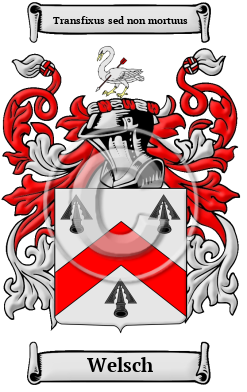
| ![Show Contents]() Welsch History, Family Crest & Coats of Arms Welsch History, Family Crest & Coats of Arms
Etymology of WelschWhat does the name Welsch mean? With the arrival of the Norman invasion of Ireland in the 11th century came new naming traditions to the eastern region of Ireland. These new naming traditions actually meshed fairly well with the pre-existing Irish traditions. Both cultures made significant use of hereditary surnames. And like the native Irish, the Strongbownians often used prefixes to build patronymic surnames, which are names based on the given name of the initial bearer's father or another older relative. Strongbow's followers often created names that were built with the prefix Fitz-, which was derived from the French word fils, and ultimately from the Latin filius, both of which mean son. They also used diminutive suffixes such as -ot, -et, -un, -in, or -el, and occasionally even two suffixes combined to form a double diminutive such as -el-in, -el-ot, -in-ot, and -et-in, to build patronymic names. The surname Welsch is derived from Breat(h)nach which literally means Welshman. Phillip Brenagh, known as "Phillip the Welshman" was likely the progenitor of the family. Phillip and his brother David arrived with Strongbow, in 1170. Early Origins of the Welsch familyThe surname Welsch was first found in Counties Kilkenny, Leix, and Waterford, in Ireland, where they held a family seat from 1170. Early History of the Welsch familyThis web page shows only a small excerpt of our Welsch research. Another 129 words (9 lines of text) covering the years 1170, 1580, 1604, 1606, 1615, 1618, 1654 and 1688 are included under the topic Early Welsch History in all our PDF Extended History products and printed products wherever possible. Welsch Spelling VariationsDuring the Middle Ages, a single person often had their name recorded by church officials and scribes many different ways. Names were typically spelt as they sounded, which resulted in many different spelling variations. The many versions of the name Welsch to have been recorded over the years include: Walsh, Welsh, Welch, Brannagh and others. Early Notables of the Welsch familyRev. Peter Walsh (1618-1688), who wrote "The Loyal Remonstrance"; for which he was excommunicated from the Franciscan Order; John Walsh who wrote "Lament for Oliver Grace" in 1604; Most...
Another 29 words (2 lines of text) are included under the topic Early Welsch Notables in all our PDF Extended History products and printed products wherever possible. Welsch RankingIn the United States, the name Welsch is the 14,710th most popular surname with an estimated 2,487 people with that name. 1 However, in France, the name Welsch is ranked the 5,515th most popular surname with an estimated 1,000 - 1,500 people with that name. 2
| Welsch migration to the United States | + |
In the 1840s, Ireland experienced a mass exodus to North America due to the Great Potato Famine. These families wanted to escape from hunger and disease that was ravaging their homeland. With the promise of work, freedom and land overseas, the Irish looked upon British North America and the United States as a means of hope and prosperity. Those that survived the journey were able to achieve this through much hard work and perseverance. Early immigration and passenger lists revealed many bearing the name Welsch:
Welsch Settlers in United States in the 18th Century- William Welsch, who arrived in Virginia in 1717 3
- Johan Jacob Welsch, who arrived in Pennsylvania in 1737 3
- Johan Michael Welsch, who landed in Pennsylvania in 1741 3
- Johann Wilhelm Welsch, who arrived in Pennsylvania in 1741 3
- David Welsch, who landed in Pennsylvania in 1752 3
- ... (More are available in all our PDF Extended History products and printed products wherever possible.)
Welsch Settlers in United States in the 19th Century- Mr. Peter Carl Welsch, German who arrived in Galveston, Texas in 1846 aboard the ship "Colchis"
- Wolfgang Welsch, who landed in St Clair County, Illinois in 1852 3
- Peter Welsch, who arrived in St Clair County, Illinois in 1856 3
- George Welsch, who landed in St Clair County, Illinois in 1860 3
- James Welsch, aged 31, who landed in New York in 1868 3
- ... (More are available in all our PDF Extended History products and printed products wherever possible.)
| Contemporary Notables of the name Welsch (post 1700) | + |
- Samuel J. Welsch (1902-1990), American politician
- Roger Welsch (b. 1936), American author
- Howard Welsch (1898-1980), American film producer
- Henry Welsch (1921-1996), American football and baseball player and coach
- Roger Welsch (1936-2022), American news reporter and senior correspondent on the CBS News Sunday Morning program, winner of the Henry Fonda Award in 2005
- Samuel Welsch (1835-1901), Bohemian cantor
- Maximilian von Welsch (1671-1745), German architect
- Kurt Welsch (1917-1981), German footballer
- Johannes Welsch (b. 1960), German percussionist
- ... (Another 1 notables are available in all our PDF Extended History products and printed products wherever possible.)
The motto was originally a war cry or slogan. Mottoes first began to be shown with arms in the 14th and 15th centuries, but were not in general use until the 17th century. Thus the oldest coats of arms generally do not include a motto. Mottoes seldom form part of the grant of arms: Under most heraldic authorities, a motto is an optional component of the coat of arms, and can be added to or changed at will; many families have chosen not to display a motto.
Motto: Transfixus sed non mortuus
Motto Translation: Transfixed but not dead.
- "What are the 5,000 Most Common Last Names in the U.S.?". NameCensus.com, https://namecensus.com/last-names/
- http://www.journaldesfemmes.com/nom-de-famille/nom/
- Filby, P. William, Meyer, Mary K., Passenger and immigration lists index : a guide to published arrival records of about 500,000 passengers who came to the United States and Canada in the seventeenth, eighteenth, and nineteenth centuries. 1982-1985 Cumulated Supplements in Four Volumes Detroit, Mich. : Gale Research Co., 1985, Print (ISBN 0-8103-1795-8)
 |