|
![Show Contents]() Tait History, Family Crest & Coats of Arms Tait History, Family Crest & Coats of Arms
The Tait surname is derived from the Old English personal name "Tata," which may have been a shortened version of some other names. 1 Early Origins of the Tait familyThe surname Tait was first found in Suffolk, where a records from the Abbey of Bury St. Edmonds, lists an Uluric Tates in circa 1095. A record from the Rotuli Hundredorum shows Richard Tate in Cambridgeshire in 1279. In Coventry, a John Tate obtained Whiteley, county Nottingham from William Palmer in the year 1392. 2 Early History of the Tait familyThis web page shows only a small excerpt of our Tait research. Another 36 words (3 lines of text) covering the years 1488, 1496, 1652, 1687, 1692 and 1715 are included under the topic Early Tait History in all our PDF Extended History products and printed products wherever possible. Tait Spelling VariationsSpelling variations of this family name include: Tate, Tait, Tayte and others. Early Notables of the Tait familyDistinguished members of the family include John Tate, Lord Mayor of London in 1496; his older brother Sir Robert Tate, Lord Mayor of London in 1488...
Another 26 words (2 lines of text) are included under the topic Early Tait Notables in all our PDF Extended History products and printed products wherever possible. Tait World RankingIn the United States, the name Tait is the 5,976th most popular surname with an estimated 4,974 people with that name. 3 However, in Canada, the name Tait is ranked the 938th most popular surname with an estimated 5,790 people with that name. 4 And in Australia, the name Tait is the 619th popular surname with an estimated 6,282 people with that name. 5 New Zealand ranks Tait as 284th with 2,149 people. 6 The United Kingdom ranks Tait as 565th with 11,518 people. 7
 Tait migration to the United States Tait migration to the United States | + |
Some of the first settlers of this family name were: Tait Settlers in United States in the 17th Century- Magnus Tait, who settled in East New Jersey in 1685
- Patrick Tait, who settled in East New Jersey in 1685
Tait Settlers in United States in the 18th Century- David Tait, who arrived in Florida in 1769
- James Tait, who arrived in Boston in 1774
- Elizabeth Tait, who settled in Savannah, Georgia in 1775
- David Tait, aged 7, who arrived in Savanna(h), Georgia in 1775 8
Tait Settlers in United States in the 19th Century- James Tait, aged 37, who landed in South Carolina in 1812 8
- James Tait, who landed in Charleston, South Carolina in 1813 8
- William Tait, who landed in Allegany (Allegheny) County, Pennsylvania in 1818 8
- James Tait, who settled in Baltimore Maryland with his son in 1820
- Robert Tait, who arrived in New York in 1838 8
- ... (More are available in all our PDF Extended History products and printed products wherever possible.)
| Tait migration to Canada | + |
Some of the first settlers of this family name were: Tait Settlers in Canada in the 18th CenturyTait Settlers in Canada in the 19th Century- George Tait, a planter in Trinity, Newfoundland, in 1822 10
- John Tait, who arrived in Saint John, New Brunswick aboard the ship "Daniel O'Connell" in 1834
- Andrew Tait, who arrived in New Brunswick in 1847
Tait Settlers in Canada in the 20th Century- John Tait, who arrived in Saint John, New Brunswick in 1907
| Tait migration to Australia | + |
Emigration to Australia followed the First Fleets of convicts, tradespeople and early settlers. Early immigrants include: Tait Settlers in Australia in the 19th Century- Mr. Thomas Tait, English convict who was convicted in Kent, England for 14 years , transported aboard the "Duke of Portland" in January 1807, arriving in New South Wales, Australia 11
- James Tait, aged 30, who arrived in Adelaide, Australia aboard the ship "Palmyra" in 1839 12
- Helen Tait, aged 22, who arrived in Adelaide, Australia aboard the ship "Palmyra" in 1839 12
- Anne Tait, aged 4, who arrived in Adelaide, Australia aboard the ship "Palmyra" in 1839 12
- Alexander Tait, aged 2, who arrived in Adelaide, Australia aboard the ship "Palmyra" in 1839 12
- ... (More are available in all our PDF Extended History products and printed products wherever possible.)
| Tait migration to New Zealand | + |
Emigration to New Zealand followed in the footsteps of the European explorers, such as Captain Cook (1769-70): first came sealers, whalers, missionaries, and traders. By 1838, the British New Zealand Company had begun buying land from the Maori tribes, and selling it to settlers, and, after the Treaty of Waitangi in 1840, many British families set out on the arduous six month journey from Britain to Aotearoa to start a new life. Early immigrants include: Tait Settlers in New Zealand in the 19th Century- Mr. Andrew Tait, British settler travelling from Gravesend, UK aboard the ship "Dinapore" arriving in Auckland, New Zealand on 5th August 1857 13
- Mrs. Tait, British settler travelling from Gravesend, UK aboard the ship "Dinapore" arriving in Auckland, New Zealand on 5th August 1857 13
- Child Tait, British settler travelling from Gravesend, UK aboard the ship "Dinapore" arriving in Auckland, New Zealand on 5th August 1857 13
- Mr. Robert Tait, British settler travelling from London, UK aboard the ship "British Queen" arriving in Auckland, New Zealand on 30th August 1859 13
- Mr. Samuel Tait, (b. 1846), aged 16, Scottish farm labourer, from Zetland (Shetland) travelling from London aboard the ship "Queen of Mersey" arriving in Lyttelton, Christchurch, Southland, South Island, New Zealand on 20th October 1862 14
- ... (More are available in all our PDF Extended History products and printed products wherever possible.)
| Contemporary Notables of the name Tait (post 1700) | + |
- Joseph "Joe" Tait (1937-2021), American sports broadcaster for the Cleveland Cavaliers and the Cleveland Indians, awarded the Basketball Hall of Fame 2010 Curt Gowdy Media Award
- George Edward Tait (d. 2017), American poet, writer, an educator, storyteller, journalist and activist
- Douglas Tait, American actor, stuntman, and independent filmmaker, known for his work in Star Trek, Zathura: A Space Adventure, Thor, Indiana Jones and the Kingdom of the Crystal Skull, and Land of the Lost
- Charles Tait (1768-1835), American politician, United States Senator from Georgia (1809-1819)
- Arthur Fitzwilliam Tait (1819-1905), American wildlife artist
- William Walker Tait (b. 1929), American emeritus professor of philosophy at the University of Chicago
- Michael DeWayne Tait (b. 1966), American contemporary Christian music artist
- Mrs. Marie Louise Tait B.E.M., British Healthcare Assistant for Coventry and Warwickshire Partnership NHS Trust was appointed the British Empire Medal on 8th June 2018, for services to Older and Mentally Ill Patients
- Mr. Robert William Roberston Tait M.B.E., British recipient of Member of the Order of the British Empire on 8th June 2018, for services to the Promotion of Music in Scotland and to voluntary service in Falkirk 15
- Rear-Admiral James Haldane Tait (1771-1845), Scottish Naval officer, son of William Tait of Glasgow and his wife Margaret
- ... (Another 27 notables are available in all our PDF Extended History products and printed products wherever possible.)
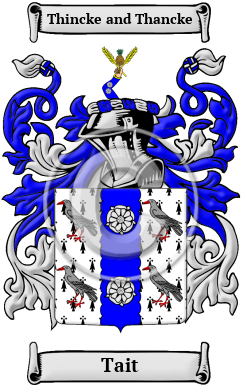
The motto was originally a war cry or slogan. Mottoes first began to be shown with arms in the 14th and 15th centuries, but were not in general use until the 17th century. Thus the oldest coats of arms generally do not include a motto. Mottoes seldom form part of the grant of arms: Under most heraldic authorities, a motto is an optional component of the coat of arms, and can be added to or changed at will; many families have chosen not to display a motto.
Motto: Thincke and Thancke
Motto Translation: Think and Thank
- Lower, Mark Anthony, Patronymica Britannica, A Dictionary of Family Names of the United Kingdom. London: John Russel Smith, 1860. Print.
- Reaney, P.H and R.M. Wilson, A Dictionary of English Surnames. London: Routledge, 1991. Print. (ISBN 0-415-05737-X)
- "What are the 5,000 Most Common Last Names in the U.S.?". NameCensus.com, https://namecensus.com/last-names/
- "Surnames Meanings, Origins & Distribution Maps - Forebears." Forebears, https://forebears.io/surnames
- "Most Common Last Names in Australia." Forebears, https://forebears.io/australia/surnames
- "Most Common Last Names in New Zealand." Forebears, https://forebears.io/new-zealand/surnames
- "UK surname ranking." UK Surname map, https://www.surnamemap.eu/unitedkingdom/surnames_ranking.php?p=10
- Filby, P. William, Meyer, Mary K., Passenger and immigration lists index : a guide to published arrival records of about 500,000 passengers who came to the United States and Canada in the seventeenth, eighteenth, and nineteenth centuries. 1982-1985 Cumulated Supplements in Four Volumes Detroit, Mich. : Gale Research Co., 1985, Print (ISBN 0-8103-1795-8)
- Rubincam, Milton. The Old United Empire Loyalists List. Genealogical Publishing Co., Inc, 1976. (Originally published as; United Empire Loyalists. The Centennial of the Settlement of Upper Canada. Rose Publishing Company, 1885.) ISBN 0-8063-0331-X
- Seary E.R., Family Names of the Island of Newfoundland, Montreal: McGill's-Queen's Universtity Press 1998 ISBN 0-7735-1782-0
- Convict Records Voyages to Australia (Retrieved 28th July 2021). Retrieved from https://convictrecords.com.au/ships/duke-of-portland
- State Records of South Australia. (Retrieved 2010, November 5) PALMYRA 1839. Retrieved from http://www.slsa.sa.gov.au/BSA/1839Palmyra.htm
- New Zealand Yesteryears Passenger Lists 1800 to 1900 (Retrieved 17th October 2018). Retrieved from http://www.yesteryears.co.nz/shipping/passlist.html
- New Zealand Yesteryears Passenger Lists 1800 to 1900 (Retrieved 26th March 2019). Retrieved from http://www.yesteryears.co.nz/shipping/passlist.html
- "Birthday and New Year Honours Lists (1940 to 2019)." Issue 62310, 4 July 2019 | London Gazette, The Gazette, June 2018, https://www.thegazette.co.uk/London/issue/62310/supplement/B1
|

 Tait migration to the United States
  Tait migration to Canada
  Tait migration to Australia
  Tait migration to New Zealand

 England-Alt
 Scotland