| ![Show Contents]() Pilkenton History, Family Crest & Coats of Arms Pilkenton History, Family Crest & Coats of Arms
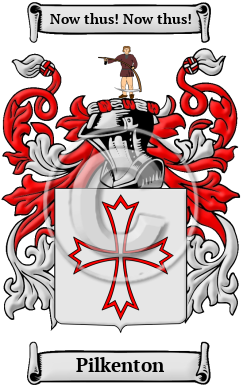
Etymology of PilkentonWhat does the name Pilkenton mean? The name Pilkenton is of Anglo-Saxon origin and came from when the family lived in Pilkington, a manor in the parish of Prestwick, Lancashire. There seems to be two early distinct entries of the various derivations of the name: William Pylk who was listed in the Assize Rolls of 1303; Peter Pylke who was listed in the Sussex Rolls of 1332 and from these an early Old English entry of Pileca which while being unrecorded was nevertheless found in Pilkington Lancashire. The other distinct origin included Alexander de Pilkington de Pilkington in 1205; and John Pylkyngton in 1470. Both origins point to the aforementioned town in Lancashire. 1 Early Origins of the Pilkenton familyThe surname Pilkenton was first found in Lancashire at Pilkington, a township in the parish of Prestwich-cum-Oldham, hundred of Salford. This distinguished Saxon family held a family seat in Lancashire since before the Norman invasion, traditionally escaping after the Battle of Hastings by posing as a thresher and hiding in a barn under hay and the flail hit first on one side and then the other, hence their motto 'Now thus, now thus' and the Family Crest of a mower." 2 However, Shirley presumes that "the more probable scene of this event, where four knights of the family were in arms on the part of Richard III [at the Battle of Bosworth.]" Shirley continues, "A right ancient family, gentlemen of repute in the county before the Conquest." 3 Another source phrases the early family history similarly: "A branch of the Pilkington family early became the principal proprietors, and few families in the county are more closely interwoven with its history than the members of this knightly house. The battle of Bosworth-Field proved almost as fatal to the fortunes of the parent stock of the Pilkingtons, as to the power of the royal tyrant Richard: and in the grant made by Henry VII. under the great seal, to Thomas, Earl of Derby, of divers manors and lands in Lancashire, forfeited by Sir Thomas Pilkington, was this manor. " 4 The ecclesiastical district of Stand in Lancashire was home to another ancient branch of the family. "An old Hall of the Pilkington family, generally known as Stand Hall, whence the place derived its name, existed so recently as 1845, when it was taken down: on the foundation stone was the date 1518. This structure was erected by the Earl of Derby, to whom the manor of Pilkington had been granted by Henry VII. after the battle of BosworthField; and the building is traditionally reported to have been five stories high, but reduced many years ago to its late elevation of three stories, the highest of the three being elaborately ornamented by the crests of the earls of Derby, the eagle and child, and the legs of Man." 4 Gilbert Pilkington (fl. 1350) was the reputed author of 'The Tournament of Tottenham,' a burlesque in verse. He is thought to have also written 'The Feest' the perhaps 'The Story of Robin Hood and Little John.' 5 Early History of the Pilkenton familyThis web page shows only a small excerpt of our Pilkenton research. Another 193 words (14 lines of text) covering the years 1520, 1527, 1561, 1562, 1564, 1565, 1568, 1576, 1599, 1631, 1638 and 1691 are included under the topic Early Pilkenton History in all our PDF Extended History products and printed products wherever possible. Pilkenton Spelling VariationsIt is only in the last few hundred years that the English language has been standardized. For that reason, early Anglo-Saxon surnames like Pilkenton are characterized by many spelling variations. As the English language changed and incorporated elements of other European languages, even literate people changed the spelling of their names. Scribes and monks in the Middle Ages spelled names they sounded, so it is common to find several variations that refer to a single person. The variations of the name Pilkenton include: Pilkington, Pilkinton and others. Early Notables of the Pilkenton familyJames Pilkington (1520-1576), Bishop of Durham from 1561 until 1576; Leonard Pilkington (1527-1599) was an English academic and clergyman, Regius Professor of Divinity at Cambridge (1561-1562), Master of St John's College, Cambridge (1561-1564); Francis Pilkington (c.1565-1638), an English composer, lutenist and singer; and Sir Thomas Pilkington (died 1691)...
Another 48 words (3 lines of text) are included under the topic Early Pilkenton Notables in all our PDF Extended History products and printed products wherever possible. Migration of the Pilkenton family to IrelandSome of the Pilkenton family moved to Ireland, but this topic is not covered in this excerpt.
Another 44 words (3 lines of text) about their life in Ireland is included in all our PDF Extended History products and printed products wherever possible. Migration of the Pilkenton familyMany English families tired of political and religious strife left Britain for the new colonies in North America. Although the trip itself offered no relief - conditions on the ships were extremely cramped, and many travelers arrived diseased, starving, and destitute - these immigrants believed the opportunities that awaited them were worth the risks. Once in the colonies, many of the families did indeed prosper and, in turn, made significant contributions to the culture and economies of the growing colonies. An inquiry into the early roots of North American families has revealed a number of immigrants bearing the name Pilkenton or a variant listed above: William Pilkington, who settled in Virginia in 1620; Margaret Pilkington and her husband, who settled in Virginia in 1635; Ashton Pilkerton, who arrived in Philadelphia in 1860.
| Contemporary Notables of the name Pilkenton (post 1700) | + |
- Bruce Pilkenton, American jockey who had the most wins by a jockey in 1983, 1988, 1983 and 1984
- Don Pilkenton, American customizer based in Ohio, United States, three-time winner of the Ridler Award, in 1993, 1996, and 1999
The motto was originally a war cry or slogan. Mottoes first began to be shown with arms in the 14th and 15th centuries, but were not in general use until the 17th century. Thus the oldest coats of arms generally do not include a motto. Mottoes seldom form part of the grant of arms: Under most heraldic authorities, a motto is an optional component of the coat of arms, and can be added to or changed at will; many families have chosen not to display a motto.
Motto: Now thus! Now thus!
- Bardsley, C.W, A Dictionary of English and Welsh Surnames: With Special American Instances. Wiltshire: Heraldry Today, 1901. Print. (ISBN 0-900455-44-6)
- Lower, Mark Anthony, Patronymica Britannica, A Dictionary of Family Names of the United Kingdom. London: John Russel Smith, 1860. Print.
- Shirley, Evelyn Philip, The Noble and Gentle Men of England; The Arms and Descents. Westminster: John Bower Nichols and Sons, 1866, Print.
- Lewis, Samuel, A Topographical Dictionary of England. Institute of Historical Research, 1848, Print.
- Smith, George (ed), Dictionary of National Biography. London: Smith, Elder & Co., 1885-1900. Print
 |