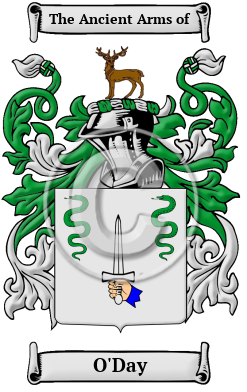
| ![Show Contents]() O'Day History, Family Crest & Coats of Arms O'Day History, Family Crest & Coats of Arms
- Origins Available:
France
Ireland
Etymology of O'DayWhat does the name O'Day mean? All Irish surnames have a unique and often romantic meaning. The name O'Day originally appeared in Gaelic as Ó Deaghaidh or Ó Diaghaidh. 1 Early Origins of the O'Day familyThe surname O'Day was first found in County Clare (Irish: An Clár) located on the west coast of Ireland in the province of Munster, where O'Dea was chief of Dysart-O'Dea, now the parish of Dysart, barony of Inchiquin, one of the original chiefs and clans of ancient Thomond. Today Dysert O'Dea Castle still stands near Corofin, County Clare with its Romanesque Doorway and High Cross and was the site of the Battle of Dysert O'Dea in 1318. It was here that the Irish chieftain Conor O'Dea, chief of the Cineal Fearmaic and ally of Murtough O'Brien, stood his ground only to be defeated by the invading forces from Scotland. Early History of the O'Day familyThis web page shows only a small excerpt of our O'Day research. Another 137 words (10 lines of text) covering the years 1318 and 1434 are included under the topic Early O'Day History in all our PDF Extended History products and printed products wherever possible. O'Day Spelling VariationsThe recording of names in Ireland in the Middle Ages was an inconsistent endeavor at best. The many regional dialects and the predominate illiteracy would have made common surnames appear unrelated to the scribes of the period. Research into the name O'Day revealed spelling variations, including Day, Dea, O'Dea and others. Early Notables of the O'Day familyMore information is included under the topic Early O'Day Notables in all our PDF Extended History products and printed products wherever possible. O'Day Rankingthe United States, the name O'Day is the 8,624th most popular surname with an estimated 2,487 people with that name. 2
| O'Day migration to the United States | + |
In the late 18th century, Irish families began emigrating to North America in the search of a plot of land to call their own. This pattern of emigration grew steadily until the 1840s when the Great Potato Famine of the 1840s cause thousands of Irish to flee the death and disease that accompanied the disaster. Those that made it alive to the shores of the United States and British North America (later to become Canada) were, however, instrumental in the development of those two powerful nations. Many of these Irish immigrants proudly bore the name of O'Day:
O'Day Settlers in United States in the 19th Century- James O'Day, who settled in America, in 1892
- Danial O'Day, aged 22, who landed in America, in 1893
- Alice O'Day, aged 26, who landed in America, in 1895
- Daniel O'Day, aged 50, who settled in America, in 1896
- Genevieve O'Day, aged 17, who immigrated to America, in 1896
- ... (More are available in all our PDF Extended History products and printed products wherever possible.)
O'Day Settlers in United States in the 20th Century- John O'Day, aged 7, who immigrated to the United States, in 1905
- George O'Day, aged 26, who landed in America from Tullycrine Co. Clare, in 1905
- Geraldine O'Day, aged 18, who immigrated to the United States, in 1906
- Edward F. O'Day, aged 24, who settled in America, in 1908
- David C O'Day, aged 50, who landed in America, in 1910
- ... (More are available in all our PDF Extended History products and printed products wherever possible.)
| O'Day migration to Canada | + |
O'Day Settlers in Canada in the 19th Century- Dennis O'Day, aged 40, a farmer, who arrived in Saint John, New Brunswick in 1833 aboard the brig "Trafalgar" from Liverpool, England
| O'Day migration to New Zealand | + |
Emigration to New Zealand followed in the footsteps of the European explorers, such as Captain Cook (1769-70): first came sealers, whalers, missionaries, and traders. By 1838, the British New Zealand Company had begun buying land from the Maori tribes, and selling it to settlers, and, after the Treaty of Waitangi in 1840, many British families set out on the arduous six month journey from Britain to Aotearoa to start a new life. Early immigrants include: O'Day Settlers in New Zealand in the 19th Century- Elizabeth O'Day, aged 21, a housemaid, who arrived in Wellington, New Zealand aboard the ship "Douglas" in 1873
| Contemporary Notables of the name O'Day (post 1700) | + |
- Pat O'Day (1934-2020), American broadcaster and concert promoter in the Pacific Northwest
- Daniel O'Day, one of northwestern Pennsylvania's earliest independent refiners to be brought into John D. Rockefeller's Standard Oil Company
- Nell O'Day (1909-1989), American equestrian and B-movie actress of the 1930s and 1940s
- Marcus Driver O'Day (1897-1961), American physicist, eponym of the O'Day lunar crater
- Molly O'Day (1911-1998), born Suzanne Dobson Noonan, an American film actress, known for The Patent Leather Kid (1927), Sea Devils (1931) and Chloe, Love Is Calling You (1934); she has a Star on the Walk of Fame
- Caroline Love Goodwin O'Day (1875-1943), American politician, the third woman, and first woman Democrat, elected to Congress from New York
- Darren O'Day (b. 1982), American Major League Baseball relief pitcher for the Texas Rangers
- Alan O'Day (1940-2013), American singer-songwriter, best known for writing and singing "Undercover Angel," an American No. 1 hit in 1977
- Hank O'Day (1862-1935), American right-handed pitcher, umpire and manager in Major League Baseball
- ... (Another 5 notables are available in all our PDF Extended History products and printed products wherever possible.)
- MacLysaght, Edward, The Surnames of Ireland. Ireland: Irish Academic Press, sixth edition, 1985. Print. (ISBN 0-7165-2366-3)
- "What are the 5,000 Most Common Last Names in the U.S.?". NameCensus.com, https://namecensus.com/last-names/
 |