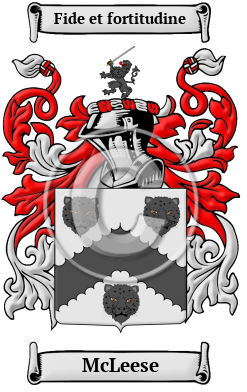
| ![Show Contents]() McLeese History, Family Crest & Coats of Arms McLeese History, Family Crest & Coats of Arms
Etymology of McLeeseWhat does the name McLeese mean? As a native Irish surname, McLeese is derived from the Gaelic name Mac Laoidhigh, which comes from the word "laoidh," which means "a poem;" or from Mac Giolla Iosa, which means "son of the devotee of Jesus." However, Lee is also a common indigenous name in England, many families of which have been established in Ireland since at least the 17th century. 1 Early Origins of the McLeese familyThe surname McLeese was first found in Connacht (Irish: Connachta, (land of the) descendants of Conn), where they were prominent in the west being anciently associated as hereditary physicians to the O'Flahertys. Families with the McLees or McAlees spellings were traditionally doctors or physicians. By the 16th century different branches had developed in Galway, in Leix, and in Munster at Cork and Limerick. The name in Gaelic was O'Laidhigh. Early History of the McLeese familyThis web page shows only a small excerpt of our McLeese research. Another 121 words (9 lines of text) covering the years 1253, 1600, 1650 and 1734 are included under the topic Early McLeese History in all our PDF Extended History products and printed products wherever possible. McLeese Spelling VariationsA name was often recorded during the Middle Ages under several different spelling variations during the life of its bearer because literacy was rare there was no real push to clearly define any of the languages found in the British Isles at that time. Variations found of the name McLeese include McAlea, McAlee, MacAlee, MacAlea, MacLee, McLee, MacLees, McLees, MacLeas, McLeas, O'Lees, O'Leas, Lee and many more. Early Notables of the McLeese familyMore information is included under the topic Early McLeese Notables in all our PDF Extended History products and printed products wherever possible.
| McLeese migration to Australia | + |
McLeese Settlers in Australia in the 19th Century- James McLeese, aged 18, who arrived in South Australia in 1850 aboard the ship "Constance" 2
| Contemporary Notables of the name McLeese (post 1700) | + |
- Peter McLeese, American director, known for The Advocates (1991) and The Black Candle (1991)
- Mary Helen McLeese, American costume designer, known for Singing to Myself (2016) and Cross Country Fun Hunt (2012)
- Brenda McLeese, American costume designer, known for Stuck (2007), Dog Pound (2010) and Vendetta: No Conscience, No Mercy (2004)
- Roy Wallace McLeese III (b. 1959), American jurist, Judge of the District of Columbia Court of Appeals (2012-)
- Jennifer M. McLeese, Canadian scientist and researcher in the Department of Zoology, University of Manitoba, Winnipeg, Manitoba
- Robert McLeese (1828-1898), Irish-born, Canadian hotelier, store owner, owner of a sternwheel river boat and politician, Member of the Legislative Assembly of British Columbia (1882-1888)
| Historic Events for the McLeese family | + |
- Miss Agnes McLeese (1886-1917), Canadian resident from Halifax, Nova Scotia, Canada who died in the Halifax Explosion (1917) 3
- Mrs. Mary McLeese (1889-1917), Canadian resident from Halifax, Nova Scotia, Canada who died in the Halifax Explosion (1917) 4
The motto was originally a war cry or slogan. Mottoes first began to be shown with arms in the 14th and 15th centuries, but were not in general use until the 17th century. Thus the oldest coats of arms generally do not include a motto. Mottoes seldom form part of the grant of arms: Under most heraldic authorities, a motto is an optional component of the coat of arms, and can be added to or changed at will; many families have chosen not to display a motto.
Motto: Fide et fortitudine
Motto Translation: By fidelity and fortitude.
- MacLysaght, Edward, Irish Families Their Names, Arms and Origins 4th Edition. Dublin: Irish Academic, 1982. Print. (ISBN 0-7165-2364-7)
- State Records of South Australia. (Retrieved 2010, November 5) CONSTANCE 1850. Retrieved http://www.slsa.sa.gov.au/BSA/1850Constance.htm
- Halifax Explosion Book of Remembrance | Maritime Museum of the Atlantic. (Retrieved 2014, June 23) . Retrieved from https://maritimemuseum.novascotia.ca/what-see-do/halifax-explosion/halifax-explosion-book-remembrance
 |