
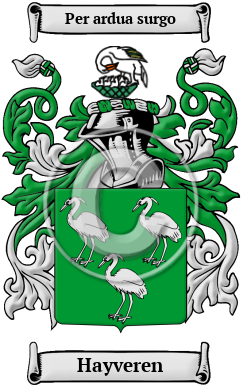
Show ContentsHayveren History, Family Crest & Coats of Arms

Etymology of Hayveren

What does the name Hayveren mean?

Many Irish surnames can be traced back to their Gaelic forms. The name Hayveren originally appeared in Gaelic as Ó hEachthigheirn or Ó hEachthigheirna, made up of the words "each" meaning "steed," and "thighearna," meaning "lord." This was first Anglicized O'Hagherin, which was later changed to O'Aherne before the prefix was eventually dropped. 1

Early Origins of the Hayveren family

The surname Hayveren was first found in County Clare (Irish: An Clár) located on the west coast of Ireland in the province of Munster, where they held a family seat as a Dalcassian sept from before the year 1000. However, with the disruptions of the Strongbow Invasion of 1172, they migrated southward to counties Cork and Waterford. In Waterford the name is predominantly Hearn and Hearne.

Early History of the Hayveren family

This web page shows only a small excerpt of our Hayveren research. Another 116 words (8 lines of text) covering the years 1420, 1566, 1754, 1769, 1797 and 1806 are included under the topic Early Hayveren History in all our PDF Extended History products and printed products wherever possible.

Hayveren Spelling Variations

The scribes who created documents long before either the Gaelic or English language resembled their standardized versions of today recorded words as they sounded. Consequently, in the Middle Ages the names of many people were recorded under different spellings each time they were written down. Research on the Hayveren family name revealed numerous spelling variations, including O'Aherne, O'Ahern, Hearne, O'Heffron, Haveran, Hayveren and many more.

Early Notables of the Hayveren family

More information is included under the topic Early Hayveren Notables in all our PDF Extended History products and printed products wherever possible.

Migration of the Hayveren family

Suffering from poverty and racial discrimination, thousands of Irish families left the island in the 19th century for North America aboard cramped passenger ships. The early migrants became settlers of small tracts of land, and those that came later were often employed in the new cities or transitional work camps. The largest influx of Irish settlers occurred with Great Potato Famine during the late 1840s. Although the immigrants from this period were often maligned when they arrived in the United States, they provided the cheap labor that was necessary for the development of that country as an industrial power. Early immigration and passenger lists have revealed many immigrants bearing the name Hayveren: James Hearn from Carrick on Suir in County Tipperary settled in Harbour Grace, Newfoundland, in 1798; James Heurn escaped from an Irish prison ship and settled at Bay Bull, Newfoundland, in 1734.


The Hayveren Motto +

The motto was originally a war cry or slogan. Mottoes first began to be shown with arms in the 14th and 15th centuries, but were not in general use until the 17th century. Thus the oldest coats of arms generally do not include a motto. Mottoes seldom form part of the grant of arms: Under most heraldic authorities, a motto is an optional component of the coat of arms, and can be added to or changed at will; many families have chosen not to display a motto.

Motto: Per ardua surgo
Motto Translation: I rise through difficulties.


  1. MacLysaght, Edward, Irish Families Their Names, Arms and Origins 4th Edition. Dublin: Irish Academic, 1982. Print. (ISBN 0-7165-2364-7)


Houseofnames.com on Facebook