| ![Show Contents]() Hay History, Family Crest & Coats of Arms Hay History, Family Crest & Coats of Arms
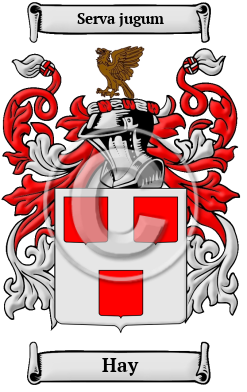
In Scottish history, few names go farther back than Hay, whose ancestors lived among the clans of the Pictish tribe. The ancestors of the Hay family lived in ancient chronicles where the tradition relating this distinguished Pictish family of Hay begins during an attack by the Danes in the reign of Kenneth III of Scotland in 980. The defeated Scottish army retired through a narrow pass near Lochnarty in Perthshire which was later defended by a local farmer and his two sons. Upbraiding the retiring Scottish army, the farmer rallied the retreating Scottish and eventually defeated the Danes. They took the yokes from the oxen with which they were ploughing, and so belaboured the invaders as to drive them from the field, amidst shouts of Hay! Hay! The King rewarded the family with many grants of land including the Carse of Gowrie on the River Tay, traditionally marked by the limit of a falcon's flight, six miles in length. There is a monument still extant called the Falcon's Stone marking the falcon's place of rest. 1 The king also assigned three shields or escutcheons for the arms of the family, to intimate that the father and his two sons had been the three fortunate shields of Scotland. Early Origins of the Hay familyThe surname Hay was first found in Perthshire (Gaelic: Siorrachd Pheairt) former county in the present day Council Area of Perth and Kinross, located in central Scotland, but looking further back we find Hay family of Normandy was of considerable rank and importance in the year 823 AD. Significantly, the family held a Coat of Arms from ancient times that consisted of three red shields on a silver background. They also held many baronies, including the Castle and Barony of La Hai-du-puits in Coutances from whence the Sire-de-la-haie came. He accompanied Duke William of Normandy in his conquest of England and was granted vast estates in Sussex, Essex and Suffolk, as recorded in the Domesday Book. He died in 1098, his daughter marrying her cousin Robert de la Haie, Count of Mortain. William de Haya, who first settled in Scotland was probably Robert's son, and he witnessed charters by King Malcolm IV in 1160 AD. 2 Early History of the Hay familyThis web page shows only a small excerpt of our Hay research. Another 250 words (18 lines of text) covering the years 1255, 1258, 1309, 1333, 1342, 1403, 1406, 1418, 1419, 1450, 1456, 1508, 1543, 1564, 1568, 1572, 1577, 1579, 1588, 1591, 1594, 1599, 1625, 1634, 1645, 1660, 1668, 1697, 1704, 1706, 1713 and 1890 are included under the topic Early Hay History in all our PDF Extended History products and printed products wherever possible. Hay Spelling VariationsAlthough Medieval Scotland lacked a basic set of spelling rules, which meant that scribes recorded names according to their sounds it was not uncommon for the names of a father and son to be recorded differently. As a result, there are many spelling variations of Scottish single names. Hay has been written Hay, Haye, Haya, Mac Garaidh (Gaelic) and others. Early Notables of the Hay familyNotable amongst the Clan at this time was - Sir Gilbert de la Haye (d. 1333), Lord High Constable of Scotland from 1309
- Gilbert Hay (c.1403), Scottish poet and translator, author of "The Buik of King Alexander the Conquerour" and other works
- Sir Thomas de la Hay (c. 1342-1406), Lord High Constable of Scotland, third member of the Hay family to hold this post, his predecessor was David Hay
- John Hay, 1st Lord Hay of Yester (1450-1508), Scottish nobleman
- George Hay, 1st Earl of Kinnoull (1572-1634), Lord Chancellor of Scotland
- Lucy Hay, Countess of Carlisle (1599-1660), an English courtier
- John Hay, 1st Marquess and 2nd Earl of Tweeddale (c.1625-1697), Lord Chancellor of Scotland
- John Hay, 2nd Marquess of Tweeddale (1645-1713), a Scottish nobleman
Hay World RankingIn the United States, the name Hay is the 2,061st most popular surname with an estimated 14,922 people with that name. 3 However, in Canada, the name Hay is ranked the 822nd most popular surname with an estimated 6,528 people with that name. 4 And in France, the name Hay is the 1,326th popular surname with an estimated 4,277 people with that name. 5 Australia ranks Hay as 369th with 9,904 people. 6 New Zealand ranks Hay as 178th with 3,055 people. 7 The United Kingdom ranks Hay as 507th with 12,814 people. 8  Migration of the Hay family to Ireland Migration of the Hay family to Ireland
Some of the Hay family moved to Ireland, but this topic is not covered in this excerpt.
Another 60 words (4 lines of text) about their life in Ireland is included in all our PDF Extended History products and printed products wherever possible.
| Hay migration to the United States | + |
Thousands of Scots left their home country to travel to Ireland or Australia, or to cross the Atlantic for the North American colonies. The difficult crossing was an enormous hurdle, but those who survived found freedom and opportunity in ample measure. Some Scots even fought for their freedom in the American War of Independence. This century, their ancestors have become aware of the illustrious history of the Scots in North America and at home through Clan societies and other organizations. Passenger and immigration lists show many early and influential immigrants bearing the name Hay:
Hay Settlers in United States in the 17th Century- Daniel Hay who settled in Maine in 1606
- Arthur Hay, who arrived in Maryland in 1641 9
- Elizabeth Hay, who settled in Virginia in 1654
- Arthur Hay, who settled in Virginia in 1663
- Thomas Hay, who landed in Maryland in 1664 9
- ... (More are available in all our PDF Extended History products and printed products wherever possible.)
Hay Settlers in United States in the 18th Century- Isaac Hay, who landed in Virginia in 1700 9
- Eliz Hay, who landed in Virginia in 1705 9
- Judah Hay, who landed in New York, NY in 1740 9
- Rebecca Hay, who landed in Augusta County, Va in 1740 9
- Robert Hay, who arrived in Augusta County, Va in 1740 9
- ... (More are available in all our PDF Extended History products and printed products wherever possible.)
Hay Settlers in United States in the 19th Century- Sampson Hay, who arrived in America in 1806 9
- Lionel Hay, aged 43, who arrived in New York in 1812 9
- Valentine Hay, who landed in Sometset County, Pennsylvania in 1833 9
- Jacob Hay, aged 24, who arrived in Missouri in 1840 9
- Archibard Hamilton Hay, who landed in Allegany (Allegheny) County, Pennsylvania in 1842 9
- ... (More are available in all our PDF Extended History products and printed products wherever possible.)
| Hay migration to Canada | + |
Some of the first settlers of this family name were: Hay Settlers in Canada in the 17th Century- Pierre Hay, son of Gabriel and Catherine, who married Geneviève Benoit, daughter of Paul and Isabelle-Élisabeth, in Boucherville, Quebec on 21st January 1689 10
- Pierre Hay, son of Gabriel and Catherine, who married Catherine Campeau, daughter of Etienne and Catherine, in Montreal, Quebec on 10th December 1696 10
Hay Settlers in Canada in the 18th Century- Pierre Hay, son of Pierre and Catherine, who married Marie-Françoise Robreau, daughter of Pierre and Jeanne, in Montreal, Quebec on 24th April 1743 10
- Alexander Hay, who landed in Nova Scotia in 1749
- James Hay, who arrived in Nova Scotia in 1749
- Thomas Hay, who landed in Nova Scotia in 1749-1752
- Charles Hay, who landed in Nova Scotia in 1749-1752
- ... (More are available in all our PDF Extended History products and printed products wherever possible.)
Hay Settlers in Canada in the 19th Century- John Hay, aged 32, a labourer, who arrived in Quebec aboard the ship "Atlas" in 1815
- William Hay, aged 50, a farmer, who arrived in Quebec aboard the ship "Atlas" in 1815
- Ann Hay, aged 43, who arrived in Quebec aboard the ship "Atlas" in 1815
- Jean Hay, aged 17, who arrived in Quebec aboard the ship "Atlas" in 1815
- William Hay, aged 15, who arrived in Quebec aboard the ship "Atlas" in 1815
- ... (More are available in all our PDF Extended History products and printed products wherever possible.)
| Hay migration to Australia | + |
Emigration to Australia followed the First Fleets of convicts, tradespeople and early settlers. Early immigrants include: Hay Settlers in Australia in the 19th Century- Mr. Robert Hay, (Colvin, John), (b. 1774), aged 29, British carrier who was convicted in Perth, Scotland for 14 years for stealing, transported aboard the "Calcutta" in February 1803, arriving in New South Wales, Australia, he died in 1839 11
- William Hay, English convict from London, who was transported aboard the "Asia" on October 22nd, 1824, settling in New South Wales, Australia 12
- Miss Ann Hay, Scottish convict who was convicted in Edinburgh, Scotland for 7 years, transported aboard the "Buffalo" on 4th May 1833, arriving in New South Wales, Australia 13
- Miss Margaret Hay, (McCormel), Scottish convict who was convicted in Jedburgh, Scotland for 7 years, transported aboard the "Buffalo" on 4th May 1833, arriving in New South Wales, Australia 13
- Mr. George Hay, (b. 1807), aged 29, Scottish soldier who was convicted in Cape Town, South Africa for 7 years, transported aboard the "Earl Grey" on 27th August 1836, arriving in New South Wales, Australia 14
- ... (More are available in all our PDF Extended History products and printed products wherever possible.)
| Hay migration to New Zealand | + |
Emigration to New Zealand followed in the footsteps of the European explorers, such as Captain Cook (1769-70): first came sealers, whalers, missionaries, and traders. By 1838, the British New Zealand Company had begun buying land from the Maori tribes, and selling it to settlers, and, after the Treaty of Waitangi in 1840, many British families set out on the arduous six month journey from Britain to Aotearoa to start a new life. Early immigrants include: Hay Settlers in New Zealand in the 19th Century- Ebenezer Hay, who landed in Wellington, New Zealand in 1840 aboard the ship Bengal Merchant 15
- Capt William Hay, who landed in Wellington, New Zealand in 1840 aboard the ship Nimrod
- W Hay, who landed in Wellington, New Zealand in 1840 aboard the ship "Bengal Merchant" 15
- William Hay, who landed in Wellington, New Zealand in 1840 aboard the ship London
- Ebenezer Hay, aged 26, who arrived in Wellington, New Zealand aboard the ship "Bengal Merchant" in 1840 16
- ... (More are available in all our PDF Extended History products and printed products wherever possible.)
| Contemporary Notables of the name Hay (post 1700) | + |
- William Winn Hay (1934-2022), American geologist, marine geologist, micropaleontologist, paleoceanographer, and paleoclimatologist from Dallas, Texas
- Kenneth Edward Hay (1933-2019), American founder of The Wilds, a Christian fundamentalist camp and conference center
- Louise Lynn Hay (1926-2017), born Helen Vera Lunney, an American motivational author and the founder of Hay House
- William E. Hay, American politician, Mayor of District Heights, Maryland, 1983-85 17
- William B. Hay, American politician, Candidate for U.S. Representative from Ohio 2nd District, 1912 17
- William Hay, American Republican politician, Presidential Elector for Pennsylvania, 1876; Presidential Elector for Pennsylvania, 1876 17
- William Hay Jr., American politician, Member of New York State Assembly from Warren County, 1827 17
- Walter G. Hay, American Republican politician, Candidate for Mayor of Portland, Maine, 1912 17
- Thomas B. Hay, American Republican politician, Alternate Delegate to Republican National Convention from Idaho, 1928 17
- Thomas A. H. Hay, American Republican politician, Alternate Delegate to Republican National Convention from Pennsylvania, 1912 17
- ... (Another 78 notables are available in all our PDF Extended History products and printed products wherever possible.)
| Historic Events for the Hay family | + |
- Mr. Matthew Hay, British Midshipman Paymaster, who sailed into battle on the HMS Prince of Wales (1941) and survived the sinking 18
- Mr. Ian Hay, British Gunner, who sailed into battle on the HMS Repulse (1941) and survived the sinking 19
Victoria steamboat disaster - John Hay, Canadian passenger who was killed in the Victoria steamboat disaster when the boat capsized in 1881
The motto was originally a war cry or slogan. Mottoes first began to be shown with arms in the 14th and 15th centuries, but were not in general use until the 17th century. Thus the oldest coats of arms generally do not include a motto. Mottoes seldom form part of the grant of arms: Under most heraldic authorities, a motto is an optional component of the coat of arms, and can be added to or changed at will; many families have chosen not to display a motto.
Motto: Serva jugum
Motto Translation: Keep the yoke.
- Lower, Mark Anthony, Patronymica Britannica, A Dictionary of Family Names of the United Kingdom. London: John Russel Smith, 1860. Print.
- Black, George F., The Surnames of Scotland Their Origin, Meaning and History. New York: New York Public Library, 1946. Print. (ISBN 0-87104-172-3)
- "What are the 5,000 Most Common Last Names in the U.S.?". NameCensus.com, https://namecensus.com/last-names/
- "Surnames Meanings, Origins & Distribution Maps - Forebears." Forebears, https://forebears.io/surnames
- http://www.journaldesfemmes.com/nom-de-famille/nom/
- "Most Common Last Names in Australia." Forebears, https://forebears.io/australia/surnames
- "Most Common Last Names in New Zealand." Forebears, https://forebears.io/new-zealand/surnames
- "UK surname ranking." UK Surname map, https://www.surnamemap.eu/unitedkingdom/surnames_ranking.php?p=10
- Filby, P. William, Meyer, Mary K., Passenger and immigration lists index : a guide to published arrival records of about 500,000 passengers who came to the United States and Canada in the seventeenth, eighteenth, and nineteenth centuries. 1982-1985 Cumulated Supplements in Four Volumes Detroit, Mich. : Gale Research Co., 1985, Print (ISBN 0-8103-1795-8)
- Internoscia, Arthur E., and Claire Chevrier. Dictionnaire National des Canadiens Français 1608-1760. Vol. 1, Institut Drouin, 1958.
- Convict Records Voyages to Australia (Retrieved 25th November 2020). Retrieved from https://convictrecords.com.au/ships/calcutta
- State Library of Queensland. (Retrieved 2016, October 27) Asia 1 voyage to Van Diemen's Land, Australia in 1824 with 9 passengers. Retrieved from http://www.convictrecords.com.au/ships/asia/1824
- Convict Records Voyages to Australia (Retrieved 3rd November 2020). Retrieved from https://convictrecords.com.au/ships/buffalo
- Convict Records Voyages to Australia (Retrieved 16th August 2021). Retrieved from https://convictrecords.com.au/ships/earl-grey
- Shadow Time Settlers (Retrieved 5th November 2010), retrieved from http://shadowsoftime.co.nz/settlers.html
- New Zealand Yesteryears Passenger Lists 1800 to 1900 (Retrieved 26th March 2019). Retrieved from http://www.yesteryears.co.nz/shipping/passlist.html
- The Political Graveyard: Alphabetical Name Index. (Retrieved 2015, November 2) . Retrieved from http://politicalgraveyard.com/alpha/index.html
- HMS Prince of Wales Crew members. (Retrieved 2014, April 9) . Retrieved from http://www.forcez-survivors.org.uk/biographies/listprincecrew.html
- HMS Repulse Crew members. (Retrieved 2014, April 9) . Retrieved from http://www.forcez-survivors.org.uk/biographies/listrepulsecrew.html
|

 Hay migration to the United States
  Hay migration to Canada
  Hay migration to Australia
  Hay migration to New Zealand

 France
 Scotland
 Ireland
 England