| ![Show Contents]() French History, Family Crest & Coats of Arms French History, Family Crest & Coats of Arms
When the Anglo-Normans began to settle in Ireland, they brought the tradition of local surnames to an island which already had a Gaelic naming system of hereditary surnames established. Unlike the Irish, the Anglo-Normans had an affinity for local surnames. Local surnames, such as French, were formed from the names of a place or a geographical landmark where the person lived, held land, or was born. The earliest Anglo-Norman surnames of this type came from Normandy, but as the Normans moved, they created names that referred to where they actually resided. Therefore, English places were used for names when the Normans lived in England, and then Irish places after these particular Anglo-Normans had been settled in Ireland for some time. Originally, these place names were prefixed by "de," which means "from" in French. However, this type of prefix was eventually either made a part of the surname, if the place name began with a vowel, or it was eliminated entirely. The French family originally lived near an ash tree. The surname French was originally de Freynes and was originally derived from the word "fraxinus," which means an "ash tree." However, in some cases, the surname French is derived from residence in the country of France, a more obvious derivation. The name is sometimes spelled with a beginning of "Ff." This practice arose as many early records showed the capital "F" as "ff" in 16th and 17th centuries. The family claim descent from "one of the 'Tribes of Galway' though first settled in Co. Wexford. The name is derived from the Latin fraxinus, [meaning] ash tree." 1 Early Origins of the French familyThe surname French was first found in Devon. They were descendants of Theophilus de France who accompanied William the Conqueror into England in 1066. Robert Fitz-Stephen de France accompanied Strongbow, Earl of Pembroke, on his invasion of Ireland. Early History of the French familyThis web page shows only a small excerpt of our French research. Another 86 words (6 lines of text) covering the years 1274, 1329, 1489, 1538, 1539, 1546, 1582, 1583, 1602, 1604, 1616, 1637, 1650, 1651, 1657, 1666, 1678, 1693 and 1713 are included under the topic Early French History in all our PDF Extended History products and printed products wherever possible. French Spelling VariationsMedieval scribes and church officials spelt names simply the way they sounded, which explains the various name spelling variations of the name French that were encountered when researching that surname. The many spelling variations included: French, Frenche and others. Early Notables of the French familyNotable amongst the family up to this time was - Seán an tSalainn French (1489-1546), member of one of The Tribes of Galway, Mayor of Galway (1538 to 1539)
- Robuck French fitz John, (died 1602), Mayor of Galway (1582-1583)
- Nicholas French (1604-1678), Roman Catholic Bishop of Ferns
- John French (1616-1657), an English physician known for his contributions to chemistry and in particular to distillation, English translator of Latin and German works, obtained a B.A. degree from Oxfo...
- Sir Oliver Óge French (died 1666), an Irish merchant and Mayor of Galway (1650-1651)
- Christopher French (fl. c. 1650-c.1713), Irish theologian, member of the Dominican Order
French World RankingIn the United States, the name French is the 442nd most popular surname with an estimated 64,662 people with that name. 2 However, in Canada, the name French is ranked the 614th most popular surname with an estimated 8,321 people with that name. 3 And in Newfoundland, Canada, the name French is the 100th popular surname with an estimated 323 people with that name. 4 Australia ranks French as 281st with 12,419 people. 5 New Zealand ranks French as 412nd with 1,597 people. 6 The United Kingdom ranks French as 291st with 20,919 people. 7
 French migration to the United States French migration to the United States | + |
During the middle of the 19th century, Irish families often experienced extreme poverty and racial discrimination in their own homeland under English rule. Record numbers died of disease and starvation and many others, deciding against such a fate, boarded ships bound for North America. The largest influx of Irish settlers occurred with Great Potato Famine of the late 1840s. Unfortunately, many of those Irish that arrived in Canada or the United States still experienced economic and racial discrimination. Although often maligned, these Irish people were essential to the rapid development of these countries because they provided the cheap labor required for the many canals, roads, railways, and other projects required for strong national infrastructures. Eventually the Irish went on to make contributions in the less backbreaking and more intellectual arenas of commerce, education, and the arts. Research early immigration and passenger lists revealed many early immigrants bearing the name French:
French Settlers in United States in the 17th Century- Alice French of Suffolk, sailed from Isle of Wight arriving in Salem, Massachusetts in 1630 aboard the ship "Ambrose" as part of the Winthrop Fleet, found in Boston 8
- John French of Suffolk, sailed from Isle of Wight arriving in Salem, Massachusetts in 1630 aboard the ship "Ambrose" as part of the Winthrop Fleet, found in Dorchester 8
- Thomas French of Suffolk, sailed from Isle of Wight arriving in Salem, Massachusetts in 1630 aboard the ship "Ambrose" as part of the Winthrop Fleet, found in Boston 8
- Miss Mary French of Suffolk, sailed from Isle of Wight arriving in Salem, Massachusetts in 1630 aboard the ship "Ambrose" as part of the Winthrop Fleet, found in Boston 9
- Miss Susan French of Suffolk, sailed from Isle of Wight arriving in Salem, Massachusetts in 1630 aboard the ship "Ambrose" as part of the Winthrop Fleet, found in Boston 9
- ... (More are available in all our PDF Extended History products and printed products wherever possible.)
French Settlers in United States in the 18th Century- Philip French, who landed in North Carolina in 1702 8
- Thomas French, who landed in Virginia in 1714 8
- Benja French, who landed in Virginia in 1714 8
- Phillip French, who arrived in Virginia in 1719 8
- Katherine French, who landed in Virginia in 1723 8
- ... (More are available in all our PDF Extended History products and printed products wherever possible.)
French Settlers in United States in the 19th Century- Shepherd French, aged 45, who arrived in New York, NY in 1803 8
- Jacob French, who landed in New York, NY in 1834 8
- William French, who landed in Allegany (Allegheny) County, Pennsylvania in 1844 8
- Austin French, who landed in Savanna(h), Georgia in 1846 8
- C C French, who arrived in San Francisco, California in 1850 8
- ... (More are available in all our PDF Extended History products and printed products wherever possible.)
| French migration to Canada | + |
Some of the first settlers of this family name were: French Settlers in Canada in the 18th Century- Mr. Albert French U.E. who settled in Canada c. 1784 10
- Mrs. Charity French U.E. who settled in Saint John, New Brunswick c. 1784 10
- Capt. James French U.E. (b. 1745) born in New York, USA who settled in York County, New Brunswick c. 1784 he served in DeLancey's 1st Battalion he died in 1820 in Nashwaak, New Brunswick 10
- Capt. Lt. Jeremiah French Sr., U.E. (b. 1743) born in Stratford, Connecticut, USA from Manchester, Vermont, USA who settled in Eastern District, Cornwall, Ontario c. 1784 he enlisted in 1777 severd in the Queen's Loyal Rangers and the King's Royal Regiment of New York he died in 1820, married Elizabeth Wheeler they had 9 children 10
- Mr. Jeremiah French Jr., U.E. who settled in Canada c. 1784 10
- ... (More are available in all our PDF Extended History products and printed products wherever possible.)
French Settlers in Canada in the 19th Century- John French, aged 24, who arrived in Canada in 1823
- Mary French, aged 24, who arrived in Canada in 1823
- Sarah French, aged 2, who landed in Canada in 1823
- Nichols French, who landed in Canada in 1828
- Anthony French, aged 28, a gentleman, who arrived in Saint John, New Brunswick in 1834 aboard the schooner "Jane" from Galway, Ireland
- ... (More are available in all our PDF Extended History products and printed products wherever possible.)
| French migration to Australia | + |
Emigration to Australia followed the First Fleets of convicts, tradespeople and early settlers. Early immigrants include: French Settlers in Australia in the 19th Century- Miss Mary French, (b. 1790), aged 22, English convict who was convicted in Devon, England for 7 years for larceny, transported aboard the "Emu" in October 1812, the ship was captured and the passengers put ashore, she died in 1813 after being rescued 11
- Mr. Edward French, (b. 1777), aged 25, Cornish settler convicted in Cornwall, UK on 27th July 1812, sentenced for 14 years for stealing sheep from Mark Foster of Lostwithiel, transported aboard the ship "Earl Spencer" in June 1813 to New South Wales, Australia 12
- Mr. Edward French, (b. 1786), aged 27, English labourer who was convicted in Cornwall, England for 14 years for stealing, transported aboard the "Earl Spencer" in May 1813, arriving in New South Wales, Australia, he died in 1834 13
- Mr. William French, English convict who was convicted in Oxford, Oxfordshire, England for 7 years, transported aboard the "Baring" in December 1818, arriving in New South Wales, Australia 14
- Mr. John French, British Convict who was convicted in Worcester, Worcestershire, England for 14 years, transported aboard the "Elizabeth" on 11th August 1820, arriving in New South Wales, Australia 15
- ... (More are available in all our PDF Extended History products and printed products wherever possible.)
| French migration to New Zealand | + |
Emigration to New Zealand followed in the footsteps of the European explorers, such as Captain Cook (1769-70): first came sealers, whalers, missionaries, and traders. By 1838, the British New Zealand Company had begun buying land from the Maori tribes, and selling it to settlers, and, after the Treaty of Waitangi in 1840, many British families set out on the arduous six month journey from Britain to Aotearoa to start a new life. Early immigrants include: French Settlers in New Zealand in the 19th Century- Mr. Thomas French, (b. 1827), aged 31, British shepherd travelling from Gravesend aboard the ship "Indiana" arriving in Lyttelton, Christchurch, South Island, New Zealand on 28th November 1858 16
- Mr. Henry French, British settler travelling from London aboard the ship "Joseph Fletcher" arriving in Auckland, New Zealand on 18th August 1859 16
- Mrs. Emily French, British settler travelling from London aboard the ship "Joseph Fletcher" arriving in Auckland, New Zealand on 18th August 1859 16
- Mr. Louis French, British settler travelling from London aboard the ship "Joseph Fletcher" arriving in Auckland, New Zealand on 18th August 1859 16
- Miss Lilla French, British settler travelling from London aboard the ship "Joseph Fletcher" arriving in Auckland, New Zealand on 18th August 1859 16
- ... (More are available in all our PDF Extended History products and printed products wherever possible.)
| French migration to West Indies | + |
The British first settled the British West Indies around 1604. They made many attempts but failed in some to establish settlements on the Islands including Saint Lucia and Grenada. By 1627 they had managed to establish settlements on St. Kitts (St. Christopher) and Barbados, but by 1641 the Spanish had moved in and destroyed some of these including those at Providence Island. The British continued to expand the settlements including setting the First Federation in the British West Indies by 1674; some of the islands include Barbados, Bermuda, Cayman Island, Turks and Caicos, Jamaica and Belize then known as British Honduras. By the 1960's many of the islands became independent after the West Indies Federation which existed from 1958 to 1962 failed due to internal political conflicts. After this a number of Eastern Caribbean islands formed a free association. 17French Settlers in West Indies in the 17th Century- John French, who settled in St. Christopher (Saint Kitts) in 1634
- Mr. John French, (b. 1617), aged 18, British settler traveling aboard the ship "Paul of London" arriving in St Christopher (Saint Kitts) in 1635 18
| Contemporary Notables of the name French (post 1700) | + |
- James R. French (1928-2017), American radio presenter and producer of over 803 radio shows including The Adventures of Harry Nile and The Further Adventures of Sherlock Holmes series
- Brigadier-General Charles Augustus French (1888-1982), American Commanding Officer 68th Anti-Aircraft Artillery Brigade (1943-1945) 19
- Ray French (1895-1978), American Major League shortstop
- Kenneth French (b. 1954), American economist
- Charles "Charlie" Calvin French (1883-1962), American Major League Baseball player
- Charles K. French (1860-1952), American actor
- Marilyn French (1930-2009), American author of The Women's Room, regarded as one of the great feminist writers
- James B. French, American fighter pilot and flying ace in the U.S. Navy, during World War II, credited with 11 aerial victories
- Andrew French (b. 1859), American politician, Member of Minnesota State House of Representatives, 1891-93 20
- Adonijah French, American politician, Member of Connecticut State House of Representatives from Woodbridge, 1821-23 20
- ... (Another 151 notables are available in all our PDF Extended History products and printed products wherever possible.)
| Historic Events for the French family | + |
- Ms Lillian French, Canadian resident from Halifax, Nova Scotia, Canada who died in the Halifax Explosion (1917) 21
HMS Dorsetshire - William Herbert French (d. 1945), British Able Seaman aboard the HMS Dorsetshire when she was struck by air bombers and sunk; he died in the sinking 23
- Mr. Ronald M French (b. 1920), English Stoker 1st Class serving for the Royal Navy from Colchester, Essex, England, who sailed into battle and died in the HMS Hood sinking 24
- Mr. Leslie V French (b. 1922), English Ordinary Seaman serving for the Royal Navy from Portsmouth, Hampshire, England, who sailed into battle and died in the HMS Hood sinking 24
HMS Royal Oak - Charles French (d. 1939), British Able Seaman with the Royal Navy aboard the HMS Royal Oak (1939) when she was torpedoed by U-47 and sunk; he died in the sinking 25
- Mr. Edward Stanley French, English Fireman from Linacre, Lancashire, England, who worked aboard the RMS Lusitania (1915) and died in the sinking 26
- Miss Grace Hope French, Scottish 2nd Class passenger from Scotland, who sailed aboard the RMS Lusitania (1915) and survived the sinking 27
Senghenydd colliery - Mr. Fred French (b. 1892), Welsh coal miner from Senghenydd, Caerphilly, Wales who was working at the Senghenydd colliery when there was an explosion on the 14th October 1913; he died
SS Caribou - Mr. Maxwell French (b. 1908), Newfoundland crew member from Newfoundland and Labrador was travelling aboard the railway ferry "SS Caribou" when it was struck by a German submarine torpedo on 14th October 1942, the most significant sinking in Canadian waters at that time, he died in the sinking
SS Southern Cross - Mr. George French (1889-1914), Newfoundlander from Harbour Grace who was aboard the "SS Southern Cross" when it is suspected she sank between the 31st March 1914 and early April during the storm with a heavy load of pelts; no survivors were ever found
USS Arizona - Mr. John Edmund French, American Lieutenant Commander from Washington D.C., USA working aboard the ship "USS Arizona" when she sunk during the Japanese attack on Pearl Harbor on 7th December 1941, he died in the sinking 28
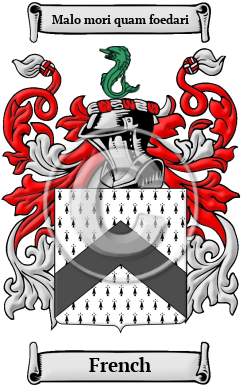
The motto was originally a war cry or slogan. Mottoes first began to be shown with arms in the 14th and 15th centuries, but were not in general use until the 17th century. Thus the oldest coats of arms generally do not include a motto. Mottoes seldom form part of the grant of arms: Under most heraldic authorities, a motto is an optional component of the coat of arms, and can be added to or changed at will; many families have chosen not to display a motto.
Motto: Malo mori quam foedari
Motto Translation: I would rather die than be disgraced.
| Suggested Readings for the name French | + |
- Ancestors and Descendants of Frank Lusk Babbott, Jr., M.D. and His Wife Elizabeth Bassett French by Harriet M. Stryker-Rodda.
- French and Related Family Genealogy: Treadway, Barrows, Ward, Lobdell, Howland, and Brewster by Mara Treadway French.
- MacLysaght, Edward, Supplement to Irish Families. Baltimore: Genealogical Book Company, 1964. Print.
- "What are the 5,000 Most Common Last Names in the U.S.?". NameCensus.com, https://namecensus.com/last-names/
- "Surnames Meanings, Origins & Distribution Maps - Forebears." Forebears, https://forebears.io/surnames
- The order of Common Surnames in 1955 in Newfoundland retrieved on 20th October 2021 (retrieved from Family Names of the Island of Newfoundland by E.R. Seary corrected edition ISBN 0-7735-1782-0)
- "Most Common Last Names in Australia." Forebears, https://forebears.io/australia/surnames
- "Most Common Last Names in New Zealand." Forebears, https://forebears.io/new-zealand/surnames
- "UK surname ranking." UK Surname map, https://www.surnamemap.eu/unitedkingdom/surnames_ranking.php?p=10
- Filby, P. William, Meyer, Mary K., Passenger and immigration lists index : a guide to published arrival records of about 500,000 passengers who came to the United States and Canada in the seventeenth, eighteenth, and nineteenth centuries. 1982-1985 Cumulated Supplements in Four Volumes Detroit, Mich. : Gale Research Co., 1985, Print (ISBN 0-8103-1795-8)
- Pilgrim Ship's of 1600's. Retrieved January 6th 2023 from https://www.packrat-pro.com/ships/shiplist.htm
- Rubincam, Milton. The Old United Empire Loyalists List. Genealogical Publishing Co., Inc, 1976. (Originally published as; United Empire Loyalists. The Centennial of the Settlement of Upper Canada. Rose Publishing Company, 1885.) ISBN 0-8063-0331-X
- Convict Records Voyages to Australia (Retrieved 3rd November 2020). Retrieved from https://convictrecords.com.au/ships/Emu
- Cornwall Online Parish Clerks. (Retrieved 30th May 2018). Retrieved from http://www.opc-cornwall.org/Resc/pdfs/emigration_australia_convicts.pdf
- Convict Records Voyages to Australia (Retrieved 8th September 2021). Retrieved from https://convictrecords.com.au/ships/earl-spencer
- Convict Records Voyages to Australia (Retrieved 16th September 2020). Retrieved from https://convictrecords.com.au/ships/baring
- Convict Records Voyages to Australia (Retrieved 3rd March 2022). Retrieved from https://convictrecords.com.au/ships/elizabeth
- New Zealand Yesteryears Passenger Lists 1800 to 1900 (Retrieved 17th October 2018). Retrieved from http://www.yesteryears.co.nz/shipping/passlist.html
- https://en.wikipedia.org/wiki/British_West_Indies
- Pilgrim Ship's of 1600's (Retrieved October 4th 2021 from https://www.packrat-pro.com/ships/shiplist.htm
- Generals of World War II. (Retrieved 2012, March 5) Charles French. Retrieved from http://generals.dk/general/French/Charles_Augustus/USA.html
- The Political Graveyard: Alphabetical Name Index. (Retrieved 2015, November 6) . Retrieved from http://politicalgraveyard.com/alpha/index.html
- Halifax Explosion Book of Remembrance | Maritime Museum of the Atlantic. (Retrieved 2014, June 23) . Retrieved from https://maritimemuseum.novascotia.ca/what-see-do/halifax-explosion/halifax-explosion-book-remembrance
- List Of Miners - Hillcrest Mine Disaster Data. (Retrieved 2014, June 24) . Retrieved from http://www.hillcrestminedisaster.com/data/index.php?title=List_Of_Miners
- Force Z Survivors HMS Dorsetshire Crew List, (Retrieved 2018, February 13th), https://www.forcez-survivors.org.uk/biographies/listdorsetshirecrew.html
- H.M.S. Hood Association-Battle Cruiser Hood: Crew Information - H.M.S. Hood Rolls of Honour, Men Lost in the Sinking of H.M.S. Hood, 24th May 1941. (Retrieved 2016, July 15) . Retrieved from http://www.hmshood.com/crew/memorial/roh_24may41.htm
- Ships hit by U-boats crew list HMS Royal Oak (08) - (Retrieved 2018 February, 9th) - retrieved from https://uboat.net/allies/merchants/crews/ship68.html
- Lusitania Passenger List - The Lusitania Resource. (Retrieved 2014, March 10) . Retrieved from http://www.rmslusitania.info/lusitania-passenger-list/
- Lusitania Passenger List - The Lusitania Resource. (Retrieved 2014, March 7) . Retrieved from http://www.rmslusitania.info/lusitania-passenger-list/
- Pearl Harbour: USS Arizona Casualties List Pearl Harbour December 7, 1941. (Retrieved 2018, July 31st). Retrieved from http://pearl-harbor.com/arizona/casualtylist.html
|

 French migration to the United States
  French migration to Canada
  French migration to Australia
  French migration to New Zealand
  French migration to West Indies

 France
 Ireland
 England