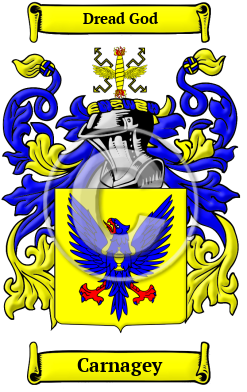
| ![Show Contents]() Carnagey History, Family Crest & Coats of Arms Carnagey History, Family Crest & Coats of Arms
- Origins Available:
Scotland
Etymology of CarnageyWhat does the name Carnagey mean? The ancient Pictish-Scottish family that first used the name Carnagey lived in the old barony of Carnegie in Angus. One of the first records of the name was Duthac de Carnegy who witnessed a deed of sale in Aberdeen in 1383. Early Origins of the Carnagey familyThe surname Carnagey was first found in Angus (Gaelic: Aonghas), part of the Tayside region of northeastern Scotland, and present day Council Area of Angus, formerly known as Forfar or Forfarshire, where the was recorded as a family of great antiquity seated at Carnegie in the parish of Carmyllis in that shire. Confirmation of the grant of lands of Cairynegy was made by King David of Scotland in 1358 to then Chief of the Clan John Carnegie. He was descended from Jocelyn of Balinhard who was the progenitor of the family. The former name of the Carnegies of Southesk was De Balinhard, but they assumed the name Carnegie in 1340 when they acquired the lands of Carnegie. Although the Clan can claim their initial descent from John de Balinhard, one of the first mentions of the name Carnegie was of Duthaac de Carnegy in 1383. A few years late, John Carnegy was the first of the name designated 'dominus ejusdem' or 'de eodem,' which is Anglicized to the expression 'of that Ilk' in 1450. The line of descent from John de Balinhard died out in the 16th century, and so a new line was taken from his son Duthac. In 1663, David, the eighth Chief, was created the Earl of Southesk. Later, James Carnegie, the fifth Earl of Southesk was present at the raising of the Standard on the Braes of Mar in 1715 and was the hero of the song "The Piper o' Dundee." His support for King James in the rising of 1715 and the defeat of the Jacobites lead eventually to the loss of the earldom. The Carnegies were generally loyal to the Stewart claim to the throne. Interestingly, Sir Alexander Cornegie of Pitarro managed to somehow have the earldom reinstated, and he became the ninth Earl of Southesk. Another branch of the family began the earldom of Ethie, and later managed to have it renamed the Earldom of Northesk in the 17th century. Early History of the Carnagey familyThis web page shows only a small excerpt of our Carnagey research. Another 108 words (8 lines of text) covering the years 1409, 1530, 1575, 1583, 1611, 1627, 1643, 1649, 1658, 1661, 1667, 1669, 1674, 1679, 1681, 1682, 1685, 1686, 1688, 1699, 1700 and 1729 are included under the topic Early Carnagey History in all our PDF Extended History products and printed products wherever possible. Carnagey Spelling VariationsThe arts of spelling and translation were yet in their infancies when surnames began, so there are an enormous number of spelling variations of the names in early Scottish records. This is a particular problem with Scottish names because of the numerous times a name might have been loosely translated to English from Gaelic and back. Carnagey has been spelled Carnegie, Carnechie, Carnegey, Carnagie, Carnagee and many more. Early Notables of the Carnagey familySir David Carnegie, 1st Earl of Southesk, 1st Baron Carnegie of Kinnaird, 1st Baron Carnegie, of Kinnaird and Leuchards (1575-1658), a Scottish nobleman; James Carnegie, 2nd Earl of Southesk (ca. 1583-1669), a Scottish nobleman; Robert Carnegie, 3rd Earl of Southesk (c.1649-1688); Charles Carnegie, 4th Earl of Southesk (1661-1699); John Carnegie, 1st Earl of Northesk (1611-1667), a Scottish noble who...
Another 59 words (4 lines of text) are included under the topic Early Carnagey Notables in all our PDF Extended History products and printed products wherever possible.
| Carnagey migration to the United States | + |
This oppression forced many Scots to leave their homelands. Most of these chose North America as their destination. Although the journey left many sick and poor, these immigrants were welcomed the hardy with great opportunity. Many of these settlers stood up for their newfound freedom in the American War of Independence. More recently, Scots abroad have recovered much of their collective heritage through highland games and other patriotic functions and groups. An examination of passenger and immigration lists has located various settlers bearing the name Carnagey:
Carnagey Settlers in United States in the 20th Century- Dale Carnagey, aged 32, who settled in Brooklyn, NY, in 1921
| Contemporary Notables of the name Carnagey (post 1700) | + |
- Dale Harbison Carnagey (1888-1955), birth name of Dale Harbison Carnegie, an American writer and lecturer and the developer of famous courses in self-improvement, salesmanship and corporate training, perhaps best known as author of How to Win Friends and Influence People (1936), a bestseller that remains popular today
The motto was originally a war cry or slogan. Mottoes first began to be shown with arms in the 14th and 15th centuries, but were not in general use until the 17th century. Thus the oldest coats of arms generally do not include a motto. Mottoes seldom form part of the grant of arms: Under most heraldic authorities, a motto is an optional component of the coat of arms, and can be added to or changed at will; many families have chosen not to display a motto.
Motto: Dread God
 |