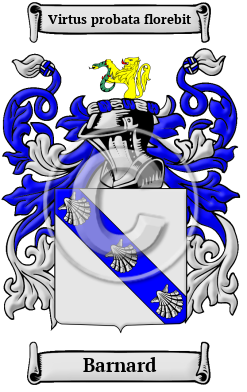
| ![Show Contents]() Barnard History, Family Crest & Coats of Arms Barnard History, Family Crest & Coats of Arms
The Strongbownian invaders added their Norman conventions for surnames to the previously established Irish system for hereditary surnames. One of the most frequent forms of surnames for both cultures was the patronymic surname, which was formed from the name of the bearer's father or grandfather. The Norman tradition that the followers of Strongbow brought with them created such a surname through diminutive suffixes such as -ot, -et, -un, -in, or -el. Occasionally, two suffixes were combined to form a double diminutive, as in the combinations of -el-in, -el-ot, -in-ot, and -et-in. The Normans also formed patronymic surnames in a manner very similar to the Irish: they added a prefix to their father's name. These Anglo-Norman people, however, used the prefix Fitz-, which was derived from the French word fils, and ultimately from the Latin filius, which both mean son. Although this prefix probably originated in Flanders or Normandy, it can now only be found in Ireland. The surname Barnard is derived from the Germanic personal name Bernhard, which consists of the elements ber or bern, which mean bear, and hard, which means brave, handy, or strong. Early Origins of the Barnard familyThe surname Barnard was first found in Westmorland, where they had been granted lands by King William for their assistance at the Battle of Hastings in 1066. Sir Theophilus, a Norman knight, who assisted William the Conqueror in the conquest of England was succeeded by his son, Sir Dorbard, who took the surname Bernard. Sir Dorbard's descendants settled at Acornbank in the county of Westmorland, but stayed in good favor with the royalty. In 1172 King Henry II took Robert Fitz Bernard with him to Ireland, in the invasion of Ireland, and entrusted to his care the counties of Wexford and Waterford. Fulk Baynard (fl. 1226), was an early Itinerant Justice, seated at Merton, Norfolk, and was specially constituted a justice for a single occasion in November 1226. 1 Robert Baynard (d. 1331), son of Fulk Baynard, was a judge and was elected knight of the shire for Norfolk several times between 1289 and 1327. 1 Early History of the Barnard familyThis web page shows only a small excerpt of our Barnard research. Another 268 words (19 lines of text) covering the years 1115, 1148, 1320, 1641, 1672, 1683, 1685, 1693, 1697, 1702, 1738, 1764, 1768 and 1903 are included under the topic Early Barnard History in all our PDF Extended History products and printed products wherever possible. Barnard Spelling VariationsMedieval scribes and church officials spelled the names as they sounded, so a name was often spelled many different ways during the lifetime of a single person. The investigation of the origin of the name Barnard revealed many spelling variations including Bernard, Barnard, Bernyrd, Barnerd, Barnart, Barnert, Barnarde and many more. Early Notables of the Barnard familyNotable amongst the family up to this time was - John Barnard (fl. 1641), was an English musician, of whose life nothing else is known and was a minor canon of St. Paul's in the reign of Charles I. "He was the first who made a collection of cathedra...
- John Barnard or Bernard (d. 1683), was the biographer of Dr. Heylyn, was the son of John Barnard, and was born at Castor, in Lincolnshire
- Another John Barnard (fl. 1685-1693), was a supporter of James II, was son of Dr. John Barnard, fellow of Lincoln College, Oxford, and sometime rector of Waddington, near Lincoln
- Sir John Barnard (1685-1764), was an English merchant and politician, born of Quaker parents at Reading in 1685
- William Barnard (1697-1768), was Bishop of Derry, the son of John Barnard, born at Clapham, Surrey, in or about 1697. 1
Barnard World RankingIn the United States, the name Barnard is the 1,355th most popular surname with an estimated 22,383 people with that name. 2 However, in the United Kingdom, the name Barnard is ranked the 638th most popular surname with an estimated 10,304 people with that name. 3 And in South Africa, the name Barnard is the 169th popular surname with an estimated 37,329 people with that name. 4
 Barnard migration to the United States Barnard migration to the United States | + |
During the middle of the 19th century, Irish families often experienced extreme poverty and racial discrimination in their own homeland under English rule. Record numbers died of disease and starvation and many others, deciding against such a fate, boarded ships bound for North America. The largest influx of Irish settlers occurred with Great Potato Famine of the late 1840s. Unfortunately, many of those Irish that arrived in Canada or the United States still experienced economic and racial discrimination. Although often maligned, these Irish people were essential to the rapid development of these countries because they provided the cheap labor required for the many canals, roads, railways, and other projects required for strong national infrastructures. Eventually the Irish went on to make contributions in the less backbreaking and more intellectual arenas of commerce, education, and the arts. Research early immigration and passenger lists revealed many early immigrants bearing the name Barnard:
Barnard Settlers in United States in the 17th Century- William Barnard, aged 21, who landed in Virginia in 1622 aboard the ship "Furtherance" 5
- John Barnard, who arrived in Boston, Massachusetts in 1630 5
- Richard Barnard, aged 24, who arrived in New York in 1633 5
- John Barnard, who landed in Cambridge, Massachusetts in 1634 5
- Massachel Barnard, who landed in Weymouth, Massachusetts in 1637 5
- ... (More are available in all our PDF Extended History products and printed products wherever possible.)
Barnard Settlers in United States in the 18th Century- Sarah Barnard, who landed in Virginia in 1719 5
- Thomas Barnard who arrived in Connecticut in 1724
- Daniel Barnard, who settled in Maryland in 1732
- John Barnard, who arrived in New Hampshire in 1740
- Francois Barnard, who arrived in Mobile, Ala in 1764 5
- ... (More are available in all our PDF Extended History products and printed products wherever possible.)
Barnard Settlers in United States in the 19th Century- Catherine Barnard, who arrived in Philadelphia in 1819
- Benjamin Barnard, who settled in New York in 1820
- Gen. Barnard, who landed in Mobile, Ala in 1822 5
- M G Barnard, who landed in San Francisco, California in 1850 5
- Nathaniel Barnard, who landed in San Francisco, California in 1850 5
- ... (More are available in all our PDF Extended History products and printed products wherever possible.)
| Barnard migration to Canada | + |
Some of the first settlers of this family name were: Barnard Settlers in Canada in the 18th Century- Matthew Barnard, who arrived in Nova Scotia in 1749
- Mrs. Barnard, who arrived in Nova Scotia in 1750
- Mathew Barnard, who landed in Nova Scotia in 1750
- Mr. Alexander Barnard U.E. who settled in Eastern District [Cornwall], Ontario c. 1783 6
- Mr. James Barnard U.E. who settled in New Brunswick c. 1783 he was a member of the Cape Ann Association 6
- ... (More are available in all our PDF Extended History products and printed products wherever possible.)
| Barnard migration to Australia | + |
Emigration to Australia followed the First Fleets of convicts, tradespeople and early settlers. Early immigrants include: Barnard Settlers in Australia in the 18th CenturyBarnard Settlers in Australia in the 19th Century- William Barnard, English convict from York, who was transported aboard the "Andromeda" on October 16, 1826, settling in Van Diemen's Land, Australia 8
- John Ewing Barnard, who arrived in Kangaroo Bay aboard the ship "Tam O'Shanter" in 1836 9
- Miss Mary Ann Barnard, English Convict who was convicted in Westminster, London, England for 7 years, transported aboard the "Atwick" on 28 September 1837, arriving in Tasmania (Van Diemen's Land) 10
- Miss Mary Ann Barnard, English Convict who was convicted in Bideford, Devon, England for 7 years, transported aboard the "Atwick" on 28 September 1837, arriving in Tasmania (Van Diemen's Land) 10
- Mrs. Mary Ann Barnard, (b. 1818), aged 19 born in Helston, Cornwall, UK convicted in Devon on 3rd July 1837, sentenced for 7 years for stealing a watch, transported aboard the ship "Atwick" in 1838 to Van Diemen's Land, Tasmania, Australia 11
- ... (More are available in all our PDF Extended History products and printed products wherever possible.)
| Barnard migration to New Zealand | + |
Emigration to New Zealand followed in the footsteps of the European explorers, such as Captain Cook (1769-70): first came sealers, whalers, missionaries, and traders. By 1838, the British New Zealand Company had begun buying land from the Maori tribes, and selling it to settlers, and, after the Treaty of Waitangi in 1840, many British families set out on the arduous six month journey from Britain to Aotearoa to start a new life. Early immigrants include: Barnard Settlers in New Zealand in the 19th Century- Alfred Barnard, who landed in Nelson, New Zealand in 1840
- Mr. James Barnard, (b. 1813), aged 26, British settler travelling from London aboard the ship "Oriental" arriving in Port Nicholson, Wellington, New Zealand on 31st January 1840 12
- Mrs. Barnard, (b. 1812), aged 27, British settler travelling from London aboard the ship "Oriental" arriving in Port Nicholson, Wellington, New Zealand on 31st January 1840 12
- Alfred Barnard, aged 23, a plumber, who arrived in Nelson, New Zealand aboard the ship "London" in 1842
- Clara Elizabeth Barnard, aged 22, who arrived in Nelson, New Zealand aboard the ship "London" in 1842
- ... (More are available in all our PDF Extended History products and printed products wherever possible.)
| Barnard migration to West Indies | + |
The British first settled the British West Indies around 1604. They made many attempts but failed in some to establish settlements on the Islands including Saint Lucia and Grenada. By 1627 they had managed to establish settlements on St. Kitts (St. Christopher) and Barbados, but by 1641 the Spanish had moved in and destroyed some of these including those at Providence Island. The British continued to expand the settlements including setting the First Federation in the British West Indies by 1674; some of the islands include Barbados, Bermuda, Cayman Island, Turks and Caicos, Jamaica and Belize then known as British Honduras. By the 1960's many of the islands became independent after the West Indies Federation which existed from 1958 to 1962 failed due to internal political conflicts. After this a number of Eastern Caribbean islands formed a free association. 13Barnard Settlers in West Indies in the 17th Century- Mr. Richard Barnard, (b. 1611), aged 23, British settler travelling from Gravesend, UK aboard the ship "Hopewell" arriving in Barbados on 17th February 1634 5
- George Barnard, who landed in Barbados in 1663 5
| Contemporary Notables of the name Barnard (post 1700) | + |
- Druie Douglas Barnard Jr. (1922-2018), American politician, Member of the U.S. House of Representatives from Georgia (1977-1993)
- Alfred James Barnard (b. 1920), American chemist and director of Analytical Services of T. J. Baker Chemical Co
- Frederick Augustus Porter Barnard (1809-1889), American scientist & educator
- Henry Barnard (1811-1900), American jurist, educator and politician
- George Grey Barnard (1863-1938), American sculptor
- Edward Emerson Barnard (1857-1923), American astronomer
- Lloyd G. Barnard, American fighter pilot and flying ace in the U.S. Navy, during World War II, credited with 8 aerial victories
- Thomas Barnard (1728-1806), Irish Bishop of Limerick, the eldest son of Dr. William Barnard, Bishop of Derry 14
- Sir Andrew Francis Barnard (1773-1855), Irish general, born at Fahan in the county of Donegal, son of the Rev. Dr. Henry Barnard, of Bovagh, County Londonderry 14
- Robert Graeme "Bob" Barnard AM (1933-2022), Australian trumpet and cornet player who was nominated for the 1996 ARIA Award for Best Jazz Album with his album Live At The Sydney Opera House
- ... (Another 6 notables are available in all our PDF Extended History products and printed products wherever possible.)
The motto was originally a war cry or slogan. Mottoes first began to be shown with arms in the 14th and 15th centuries, but were not in general use until the 17th century. Thus the oldest coats of arms generally do not include a motto. Mottoes seldom form part of the grant of arms: Under most heraldic authorities, a motto is an optional component of the coat of arms, and can be added to or changed at will; many families have chosen not to display a motto.
Motto: Virtus probata florebit
Motto Translation: Tried virtue will flourish.
- Smith, George (ed), Dictionary of National Biography. London: Smith, Elder & Co., 1885-1900. Print
- "What are the 5,000 Most Common Last Names in the U.S.?". NameCensus.com, https://namecensus.com/last-names/
- "UK surname ranking." UK Surname map, https://www.surnamemap.eu/unitedkingdom/surnames_ranking.php?p=10
- "Most Common Last Names in South Africa." Forebears, https://forebears.io/south-africa/surnames
- Filby, P. William, Meyer, Mary K., Passenger and immigration lists index : a guide to published arrival records of about 500,000 passengers who came to the United States and Canada in the seventeenth, eighteenth, and nineteenth centuries. 1982-1985 Cumulated Supplements in Four Volumes Detroit, Mich. : Gale Research Co., 1985, Print (ISBN 0-8103-1795-8)
- Rubincam, Milton. The Old United Empire Loyalists List. Genealogical Publishing Co., Inc, 1976. (Originally published as; United Empire Loyalists. The Centennial of the Settlement of Upper Canada. Rose Publishing Company, 1885.) ISBN 0-8063-0331-X
- Convict Records Voyages to Australia (Retrieved 29th September 2020). Retrieved from https://convictrecords.com.au/ships/barwell
- State Library of Queensland. (Retrieved 2016, October 27) Andromeda voyage to Van Diemen's Land, Australia in 1826 with 147 passengers. Retrieved from http://www.convictrecords.com.au/ships/andromeda/1826
- State Records of South Australia. (Retrieved 2010, November 5) TAM O'SHANTER - 1836. Retrieved from http://www.slsa.sa.gov.au/BSA/1836TamOShanter.htm
- Convict Records of Australia. Retreived 23rd August 2020 from https://convictrecords.com.au/ships/atwick
- Cornwall Online Parish Clerks. (Retrieved 30th May 2018). Retrieved from http://www.opc-cornwall.org/Resc/pdfs/tasmanian_convicts_cornish.pdf
- New Zealand Yesteryears Passenger Lists 1800 to 1900 (Retrieved 26th March 2019). Retrieved from http://www.yesteryears.co.nz/shipping/passlist.html
- https://en.wikipedia.org/wiki/British_West_Indies
- Wikisource contributors. "Dictionary of National Biography, 1885-1900." Wikisource . Wikisource , 4 Jun. 2018. Web. 6 June 2019
|

 Barnard migration to the United States
  Barnard migration to Canada
  Barnard migration to Australia
  Barnard migration to New Zealand
  Barnard migration to West Indies

 France
 Germany
 Ireland
 Scotland
 England